
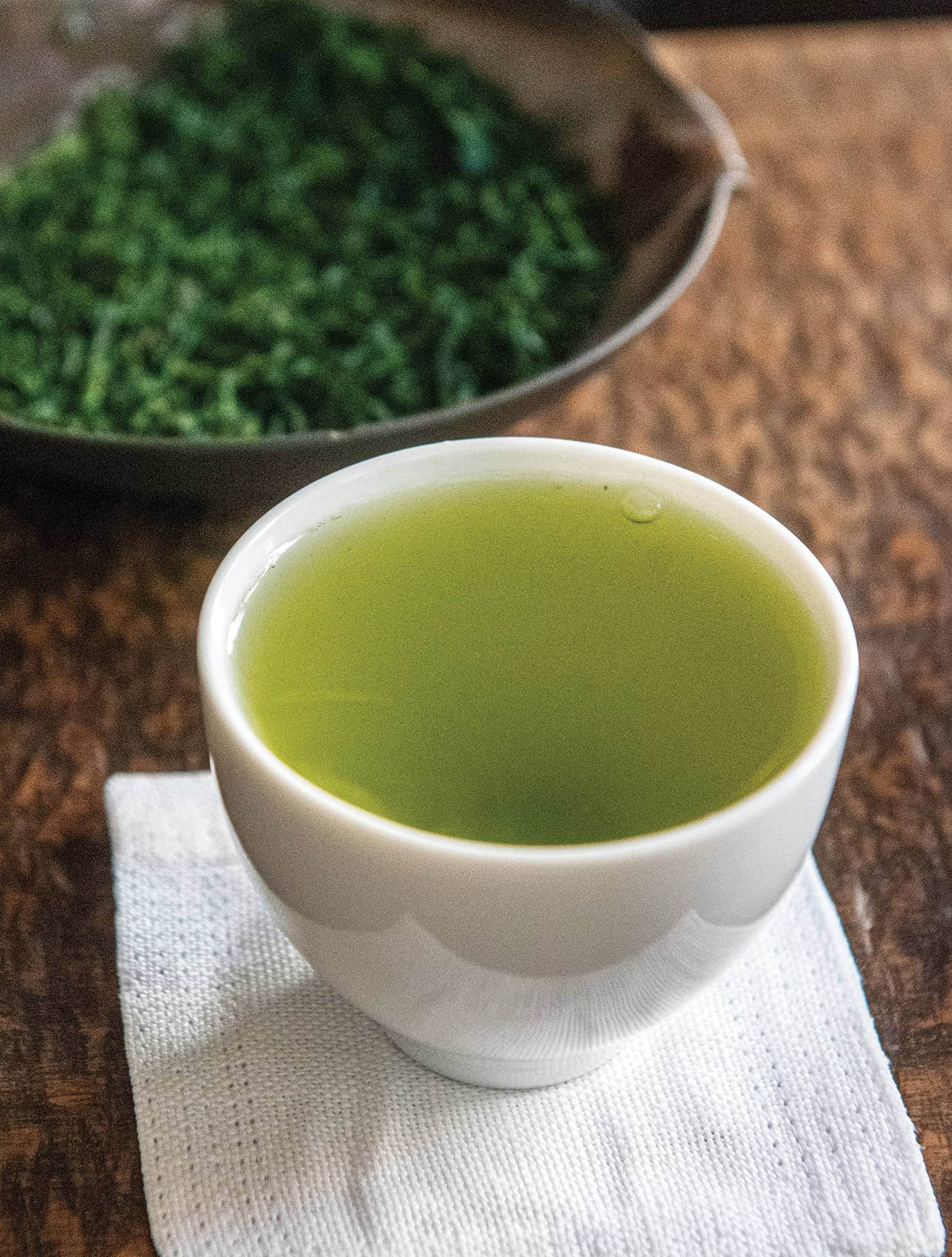
After sliding a welcome shot of chilled tea across the counter, Nobuhiko Ikematsu started to cook. In one hand he held aloft a wide, flat teapot. In the other he wielded a jagged chunk of ice with tongs, selectively moistening needle-thin tea leaves. The proprietor of Chaho Furyu reminded me of a chef basting a steak in a hot pan with butter, spinning the pot gyroscopically to achieve an even extraction. Ikematsu decanted an ounce of golden broth in front of me without ceremony. Through a translation app, and with the aid of some printouts he’d prepared for customers, he explained that this would be the first of four cups of sencha, each with its own steeping method to express the full range of the tea’s flavor. The frosty brew smelled like jasmine. First it tasted bright, then crisp, then bittersweet, like a bundle of alpine herbs from some untrodden mountain in Switzerland. Ikematsu began the second steep by blooming the leaves with boiling water, then shocking them with more ice. The aroma was stronger this time, the tea precise and balanced in a totally different way. By the time I drained my fourth cup, prepared more conventionally with hot water, I gained a prismatic appreciation for this green tea and a sneaking suspicion that whatever I knew about Japanese tea, I might as well start from scratch and learn it all again.
I was in Fukuoka, the capital city of the prefecture of the same name, to write about matcha for a magazine. It was 2025 and cafés worldwide were dusting the stuff on everything from lattes to croissants. But the longer I spent in Fukuoka, the more I wondered if matcha-obsessed Americans were missing out on the coolest teas being quietly made across Japan. If you’re newly hooked on matcha —and understandably so; it’s vividly flavored, easy to integrate into sweets and drinks, and looks great on camera—consider that it is but one treasure among many. A boom of new styles and advances in organic farming have made our current matcha moment a thrilling time to embrace other Japanese teas in all their forms. The powder is just the beginning.
While best known for green teas like matcha and sencha, Japan has a long history of other styles like black tea as well. Five of the original 15 Camellia sinensis cultivars registered nationally in 1953 were created specifically for black tea, using plant genetics from India and Sri Lanka. These were dark and tannic commodity productions made to compete in the European market; when Japanese drinkers bought black tea, they usually imported it from elsewhere. But in the last few decades, a black tea renaissance has sprouted up across Japan. Called wakocha in Japanese, the new brews aren’t just higher quality improvements on old export grades, but distinctive styles in and of themselves with soft and elegant flavors of rose, sweet potato, and cinnamon. And in the mountains of Yame, less than an hour outside Fukuoka City, Masashi Harashima has become their champion.
Harashima is a third-generation tea farmer in a region known for prizewinning green teas and an ambitious, diversified tea industry. He has 15 small fields dotting the hills of Yabe village around 2,000 feet above sea level. That’s high elevation for tea farms in Japan, and the cooler climate afforded by the mountains allows him to grow tea organically without pesticides. Ten years ago, his curiosity led him to experiment with black tea styles reminiscent of the kinds made in China and Taiwan. He studied their labor-intensive techniques and engineered processing machinery that he couldn’t buy elsewhere.
Black tea begins by withering fresh leaves in long troughs over screens to reduce their moisture content and make them pliable to work with. Then Harashima rolls them, noting his machine’s duration and pressure, and lays the bruised leaves out to oxidize, where they develop their rich, fruity flavors. All of these steps require a cook’s sensory instincts and a scientist’s penchant for record-keeping. Different seasons, the day’s weather, a cultivar’s quirks, and the quality of the pluck all demand adjustments to this procedure. Harashima makes wakocha in small batches, which is both a boon and a curse: He’s able to attenuate his processing to the needs of the leaves in front of him, but it’s an enormous effort for a small yield.
The result is extraordinary. Harashima’s wakocha possesses a depth and complexity that rival high grades from renowned black tea regions. One batch of his benifuuki cultivar opened with a roasted aroma that transitioned to rose Turkish delight and black cherry. A second brew brought a cooling wintergreen out of the leaves, a flavor that appears in many of my favorite Darjeelings . Beneath all of this was a soothing natural quality, as if this is what the tea plant always wanted to be, rather than what some human demanded of it. Harashima said he prefers plant-based fertilizers to the nitrogen-heavy fish varieties that many Japanese farmers rely on to amp up their teas’ umami; he thinks this allows more of a cultivar’s individual character to come through in the final brew.
Under the brand Chiyonoen , Harashima sells a dozen kinds of wakocha, a mix of single-cultivar productions and blends. During early spring he makes tender, lightly oxidized versions reminiscent of the high-priced Darjeeling first flush. As summer progresses, he switches to heavily oxidized batches to take advantage of the flavor-rich tannins and catechins that form in warmer weather. Three years ago, he added oolong varieties to his repertoire. They’re full of floral aromas including geranium and jasmine, and the brewed tea clung to my lips like nectar.
I love how these teas evolve from steep to steep. Matcha, like espresso, is a momentary pleasure. You drink it and it’s gone. A good loose-leaf tea can accompany you through a full afternoon of brewing. Newcomers to tea often say they appreciate how it forces them to slow down and take in the moment. This is all the more the case for whole-leaf teas that can withstand as many as five infusions, each with its own personality.
Wakocha and oolong are still niche categories in Japan; the domestic market has embraced them with intrigue, if not at scale. But there is a business case for farmers to try making them. The Japanese population is shrinking and aging. Tea farmers are getting old, too, and the retirement rate far exceeds new growers entering the industry, leading to year-over-year declines in the amount of land dedicated to tea production. Although the matcha boom has led to a surge of exports, 90 percent of Japanese tea is still consumed domestically. New styles of tea offer different opportunities to pique buyers’ interest, and they provide means for smaller producers from less famous regions to stand out from the crowd with unique flavors.
“When a Japanese black tea is well-made there really is nothing like it in the world as far as I know.”—Emily Morrison
“When a Japanese black tea is well-made there really is nothing like it in the world as far as I know,” says Emily Morrison, the founder of The Steeping Room , an online tea seller in Austin that sources specialty tea from more than 10 countries. She “actively and somewhat aggressively pursues wakocha” to offer a different perspective on black tea than most American drinkers are used to. Wakocha tends toward harmonized flavor, light body, and a mellow character with minimal bitterness or astringency. Mellow doesn’t mean boring, though: Morrison is especially excited about her teas from Hiroki Matsumoto, a youthful (by tea farmer standards) 44-year-old who makes Japan’s first smoked black tea with local woods like cherry and cedar.
She’s seen a growth of American interest in Japanese loose-leaf tea over the past few years, likely spurred on by matcha. Pursuing emerging tea categories is her way to invest in the Japanese industry. “It’s hard out there for small farmers,” she says. “Even though matcha is booming, Japanese tea farmers have been struggling with little incentive except their own passion to move in new directions.”
Tezumi , an online Japanese tea seller based in the United States, lists more than a dozen small batches of black, oolong, and “micro-oxidized” bihakkocha alongside their bestselling matcha. Co-founder David Lavecchia noted that oxidized teas are more forgiving to brew than some green styles, which can turn bitter and swampy if steeped for too long or with water that’s too hot. Tezumi commits to a wide range of oxidized teas to educate the market on what possibilities are out there, since they “span a vast range of styles that vary drastically across regions and producers.”
In parallel with this profusion of new styles, the industry has been changing the way it grows tea, with more and more farmers converting to organic production. An organic label is less of a motivator for Japanese buyers, but it’s often the difference between a sale and a skip for tea drinkers in the Americas and European Union, the latter of which has particularly stringent standards for pesticides on imports.
In the past, organic Japanese tea has come with the harsh trade-off of an unwelcome bitter character. Green styles like sencha and gyokuro (the similarly shaded loose-leaf cousin to matcha) depend on nitrogen-rich fertilizers to develop brothy sweet and umami flavors, a hallmark of Japanese tea. These fish-based fertilizers are expensive, and organic certification requires that the fish be fed an exclusively organic diet, which can raise the price out of reach for small farmers. Tea bushes are planted in dense rows that are vulnerable to pests, especially during scorching Japanese summers. Organic farmers have to find creative workarounds to problems with a limited set of tried-and-true solutions.
Kakuda Tatsuya in Okuyame is one of them. It takes three years to transition a tea field from conventional to organic, and he’s made steady progress in both methodology and tea flavor. When worms come to feast on the residue from his fish and soybean fertilizers, he sprays an organic oil on his bushes that keeps the critters away for a few days, he says. That gives him a narrow window to pluck tender new leaves. Kakuda makes delicious, reasonably priced single-cultivar sencha that I would never have clocked as compromised by organic limitations. In Yame style, he favors deeper steaming and higher firing during processing that yield a vivid green brew with satisfying notes of corn or oats. His teas are sweet and lip-smacking, like a bowl of chicken soup with a layer of rendered fat on top.
“You have to be additive,” Zach Mangan says. “If you apply conventional practices without conventional fertilizers, you’re just removing things. You’re not going to get a beautiful tea unless you do it differently.” Mangan is the founder of Kettl , a 15-year-old Brooklyn tea boutique that opened a Los Angeles branch last year. Like many American tea sellers, Mangan walks a tight rope between wanting to source responsibly made tea and meeting drinkers’ taste expectations. The farmers he works with often employ organic and no-to-low pesticide methods in the absence ofa formal label, as the certification process is expensive and bureaucratically complex. Prefectural governments like Fukuoka’s offer incentives for farmers, such as providing funding for equipment in exchange for a commitment to exploring organic practices.
Mangan is optimistic about Japan’s organic tea future. Farmers are finding cultivars that meet their needs, making new discoveries in soil biology, and trying styles like wakocha and oolong that are less dependent on a conventional fertilizer regime. Kakuda and Harashima explained that while organic tea fields yield smaller harvests than conventional ones, the plants themselves live longer and are more resilient, which is important as climate change makes the weather increasingly unpredictable.
In Fukuoka City, Mangan and I sat for tea at Yorozu , a serene teahouse with a U-shaped counter where tea makers are performers as much as brewers. Yorozu is one of many new-school Japanese spots that offers a multi-course tasting menu of tea and sweets, with seasonal options like wobbly apple-cinnamon jelly, chestnut ice cream, and a date stuffed with cultured butter and walnut that I still think about a year later. They poured me a scant splash of gyokuro that was a shock to my system: irrepressibly umami and as rich as fatty tuna.
Somewhere in the distance another customer looked transfixed by an effervescent gin cocktail spiked with sencha. I would tell you more about what was in it, but that gyokuro initiated a full software reset in my head, snapping me to attention as I wondered how much potency could be packed into 10 milliliters of liquid. “Love it or hate it, Japanese tea has the ability to punch you with intensity,” Mangan says. “It delivers this specific experience with impact.”
We’ve been lucky to feel more of that impact in the United States. Online sellers and brick-and-mortar teahouses are exposing Americans to fascinating brews that would have been impossible to find a decade ago. If this interest continues to grow, the foreign market could provide a lifeline to Japanese farmers walloped by demographic challenges and declining domestic sales. A strawberry matcha latte is a great point of entry into this world. But there are rich rewards for drinkers willing to look beyond it.
Imbibe is liquid culture. In every issue of the James Beard award-winning magazine and on our website, we celebrate drinks as a distinct culinary category, deserving in-depth exploration of the people, places, cultures and flavors that make the world of drinks so fascinating.
Call Us Toll-Free 1-877-246-2423 or 503-595-0144



Loading comments…