
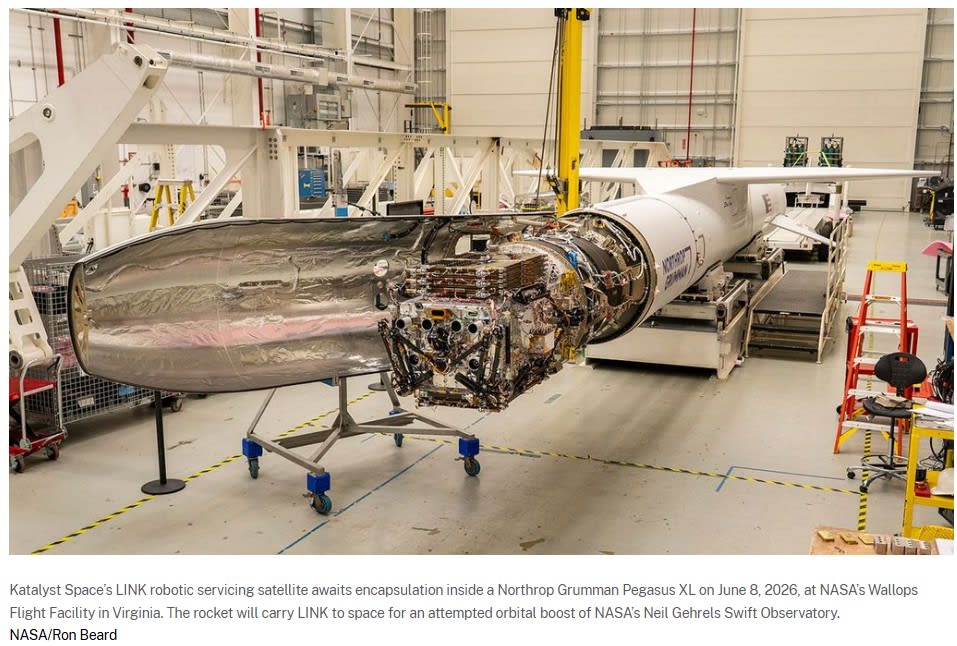
NASA’s Neil Gehrels Swift Observatory reentered this morning, bringing the 22-year-old mission to an end.
NASA contracted with Katalyst Space in September 2025 to revamp an existing system to try and rescue Swift after increased solar activity caused it to lose altitude sooner than expected. In less than nine months, Katalyst launched their LINK spacecraft to grapple Swift, but attitude control problems scuttled the effort.
Swift reentered at 7:39 am EST today over the North Sumatra region of Indonesia at approximately 3.4º N latitude, 98.6ºE degrees longitude.
Launched in 2004, Swift studied gamma-ray bursts. With three multiwavelength telescopes, Swift looked at the universe in the visible, ultraviolet, X-ray, and gamma-ray bands. In 2017, NASA named it in honor of Neil Gehrels, Swift’s Principal Investigator, after he passed away.
Last fall when it became clear increased solar activity would cause Swift to reenter sooner than expected, NASA contracted with Katalyst for $30 million to launch a rescue mission using its LINK spacecraft even though Swift wasn’t designed to be reboosted and didn’t have grappling fixtures. Katalyst’s Kieren Wilson called it an “unprepared but cooperative partner,” good at pointing. The name Swift refers to its ability to quickly repoint itself when a gamma ray burst is detected so the other instruments can study it in the X-ray and UV bands.
LINK launched on a Northrop Grumman Pegasus XL rocket from Kwajalein Atoll in the Pacific on July 3, 2026 , but soon encountered problems . An unresponsive Reaction Control System (RCS) valve caused LINK to spin up and then a power circuit switch failure doomed the effort.
Today NASA credited Swift with broadening “our understanding of a wide variety of cosmic objects and events, from active galaxies powered by supermassive black holes and stars undergoing X-ray flares, to supernova explosions and comets and asteroids in our own solar system.”
SpacePolicyOnline.com has the right (but not the obligation) to monitor the comments and to remove any materials it deems inappropriate. We do not post comments that include links to other websites since we have no control over that content nor can we verify the security of such links.



Loading comments…