
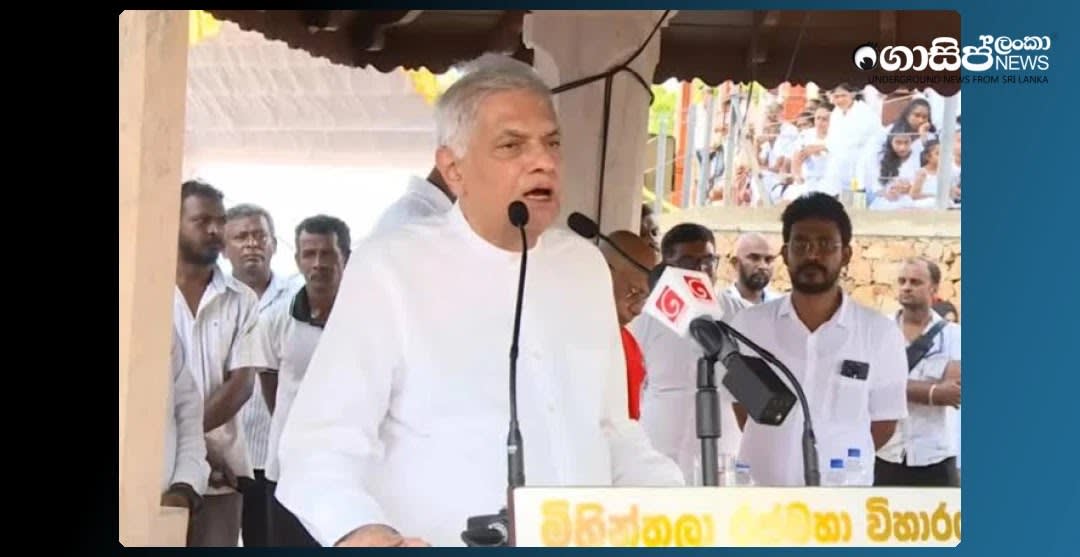
Former President Ranil Wickremesinghe, speaking at the ceremony to unveil the pinnacle of the historic Mihintale Minindhu Maha Seya, highlighted a point that adds a new dimension to the ongoing discussion in society regarding Sri Lanka's constitution and Buddhism. He emphasized that Sri Lanka is not the only country in the world that gives prominence to Buddhism.
Explaining that modern states like the Republic of Sri Lanka and the Kingdom of Thailand view Buddhism in the same way, he reminded that no religious discrimination is carried out against the people in any of these countries. The right to practice one's preferred religion, as well as full religious freedom, is affirmed for all residents in these countries. He further stated that Article 9 of the Sri Lankan Constitution grants prominence to Buddhism based on an agreement reached in the past between the British and the Kandyan leaders, and that this respect was acknowledged even when the King of England and Queen Elizabeth II visited the Sri Dalada Maligawa (Temple of the Sacred Tooth Relic) in 1954.
In Thailand, similar to Sri Lanka, where there is full religious freedom, the sovereign power of the people is exercised by the King. According to Article 67 of the Thai Constitution, the King must be a Buddhist and is instructed to protect and nourish Buddhism. Mr. Wickremesinghe stated that not only Thailand but also other Buddhist countries, including Cambodia, share a similar nature.
The roots of the similarities between these countries extend far back into history. The former President also described the historical background. After the resolution of issues that arose following the Second Buddhist Council, the Third Buddhist Council was held in Pataliputra. Subsequently, under the guidance of Emperor Ashoka, Arahant Mahinda Thero arrived in Sri Lanka and established Theravada Buddhism. He recalled how King Devanampiyatissa accepted the Dhamma and established the Mahavihara for the ordained monks. The Mahavihara, built around the Ruwanweli Seya, became the foremost educational center for Theravada Buddhism for over a thousand years. It was there that Pali Buddhism was taught, and later the Tripitaka was committed to writing on palm leaves.
Subsequently, during the reign of King Parakramabahu I, steps were taken to unify all monasteries belonging to various sects around the Mahavihara. In that era, when Polonnaruwa was the capital and Trincomalee was the main port, the Maha Sangha, including Mahasami Thero, engaged in religious activities centered in Dimbulagala. Mr. Wickremesinghe further emphasized how Sri Lanka became the center of Theravada Buddhism at that time, stating that even monks from countries like Thailand and Cambodia came to Lanka to study Theravada Buddhism.


Loading comments…