
The Weekly Epidemiological Record (WER) was first issued in 1926 by the Health Office of the League of Nations. It was entrusted to the World Health Organization (WHO) when it was created in 1948 and has appeared every week since then.
It serves as an essential instrument for the rapid and accurate dissemination of epidemiological information on cases and outbreaks of diseases under the IHR and on other communicable diseases of public health importance, including emerging or re-emerging infections.
An electronic version of the WER is accessible every Friday and can be downloaded free of charge.
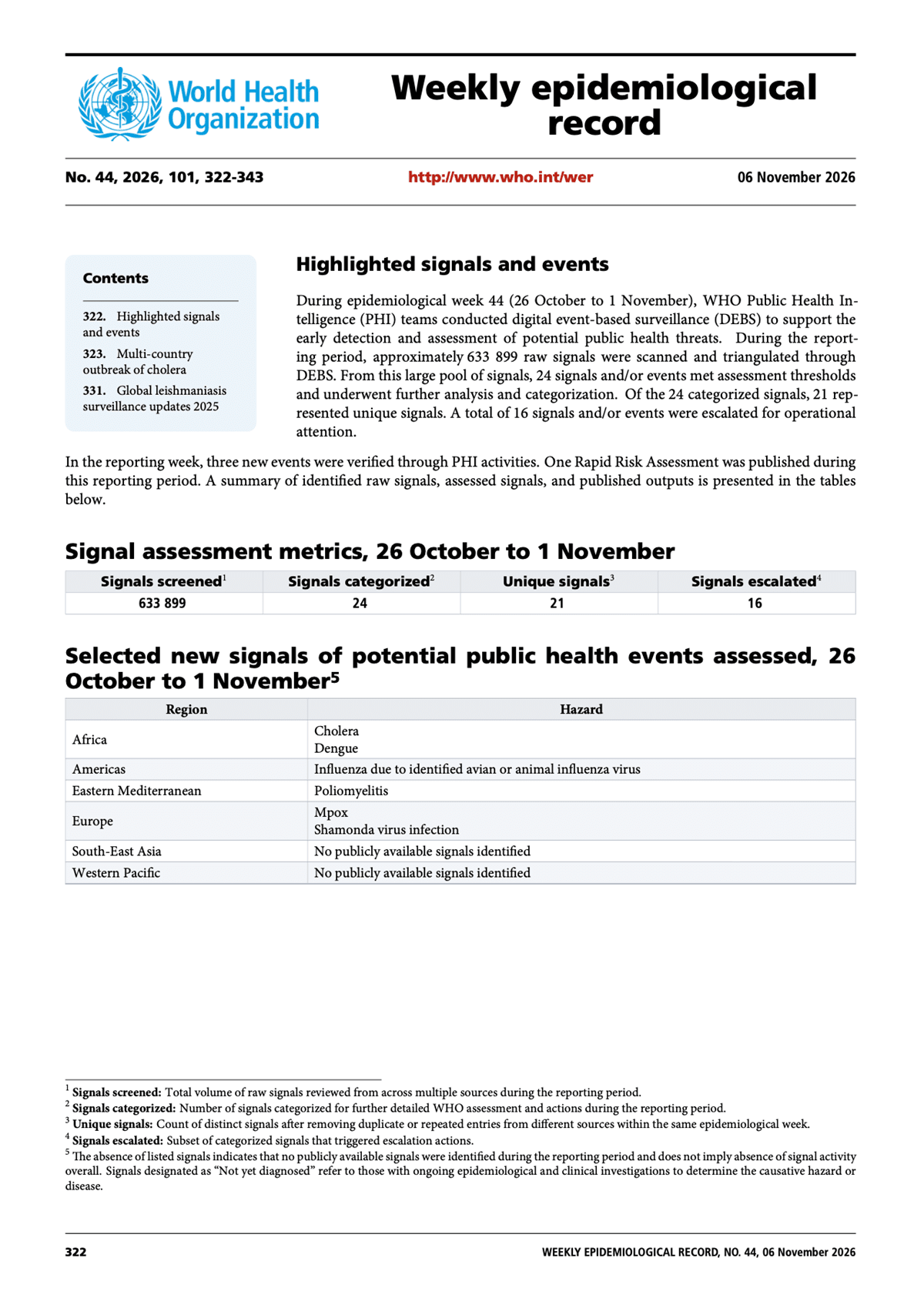
During epidemiological week 44 (26 October to 1 November), WHO Public Health Intelligence (PHI) teams conducted digital event‑based surveillance (DEBS) to support the early detection and assessment of potential public health threats. During the reporting period, approximately 633 899 raw signals were scanned and triangulated through DEBS. From this large pool of signals, 24 signals and/or events met assessment thresholds and underwent further analysis and categorization. Of the 24 categorized signals, 21 represented unique signals. A total of 16 signals and/or events were escalated for operational attention.
In the reporting week, three new events were verified through PHI activities. One Rapid Risk Assessment was published during this reporting period. A summary of identified raw signals, assessed signals, and published outputs is presented in the tables below.
1 Signals screened: Total volume of raw signals reviewed from across multiple sources during the reporting period.
2 Signals categorized: Number of signals categorized for further detailed WHO assessment and actions during the reporting period.
3 Unique signals: Count of distinct signals after removing duplicate or repeated entries from different sources within the same epidemiological week.
4 Signals escalated: Subset of categorized signals that triggered escalation actions.
5 The absence of listed signals indicates that no publicly available signals were identified during the reporting period and does not imply absence of signal activity overall. Signals designated as “Not yet diagnosed” refer to those with ongoing epidemiological and clinical investigations to determine the causative hazard or disease.
6 Only new events registered during the defined period are included, accordingly changes to disease/condition that occur after the data cut off of 23:59 on 1 November 2026 will not be reflected in the description. The absence of events indicates that no publicly available newly reported events were identified during the reporting period and does not imply absence of event activity overall.
In September 2026 (epidemiological weeks 36 to 39), a total of 32 582 new cholera and acute watery diarrhoea (AWD) cases were reported from 19 countries across four WHO regions, representing a 24% decrease from the previous month and a 37% decrease compared with the same period last year (51 480 cases across 23 countries).
In September 2026, the Eastern Mediterranean Region (17 810 cases; four countries) reported the highest number of cases, followed by the African Region (14 749 cases; 13 countries), the Region of the Americas (15 cases; one country), the South-East Asia Region (eight cases; one country). No cases were reported from the European Region or the Western Pacific Region.
During the same period, 379 cholera-related deaths were reported globally, representing a 2% increase compared with the previous month. The highest number of deaths was recorded in the African Region (346 deaths; eight countries), followed by the Eastern Mediterranean Region (33 deaths; three countries). No deaths were reported from the Region of the Americas, the South-East Asia Region, the European Region, or the Western Pacific Region.
The data presented here should be interpreted with caution. Potential underreporting and reporting delays may affect timeliness and accuracy, while variations in surveillance systems, standard case definitions, and laboratory capacities can limit direct comparability among countries. These factors also influence the global case fatality rate (CFR), requiring careful examination. Unless otherwise specified, the term ‘cholera cases’ includes both suspected and confirmed cases. Data in this report may be adjusted retrospectively as more information becomes available. For the latest data, please refer to the WHO Global Cholera and AWD Dashboard .
From 1 January to 27 September 2026, a cumulative total of 308 956 cholera and AWD cases and 3018 deaths were reported from 28 countries across four WHO regions, representing 42% decrease in cases and 56% decrease in deaths compared with the same period last year (531 412 cases and 6 881 deaths, 32 countries). The region with the highest reported case count was the African Region (169 880 cases; 19 countries), followed by the Eastern Mediterranean Region (137 982 cases; five countries), the Region of the Americas (760 cases; one country), the South-East Asia Region (334 cases; three countries). No cases were reported from the European Region or the Western Pacific Region. During the same period, cholera deaths were reported in the African Region (2671 deaths), the Eastern Mediterranean Region (345 deaths), the Region of the Americas (two deaths). No deaths were reported in other regions.
* Case and death numbers presented are not directly comparable due to differences in case definitions, reporting systems, and general underreporting. All data are subject to verification and change due to data availability and accessibility. Respective figures and numbers will be updated as more information becomes available. The data in Table 1 includes suspected, rapid diagnostic test (RDT) positive, and culture-confirmed cholera cases. As multiple countries report only total data on deaths, the reported CFR is calculated throughout based on the total number of deaths reported. The Global Task Force on Cholera Control (GTFCC) recommends that CFR be calculated using only facility deaths, with the number of community deaths reported separately.
** Missing data in this report do not imply the absence of cholera or AWD cases or deaths in the respective country. The data presented in this report are based on the latest available information and may not reflect the current situation.
† Afghanistan and Myanmar report AWD cases.
§ The reported number of suspected cholera and AWD cases is based on the available Public Health Bulletin published by the National Institute of Health of Pakistan .
¥ Since week 18, data from Yemen cover only Internationally Recognized Government (IRG) controlled areas.
‡ Among the total of 36 cases reported from India, 27 cases were confirmed.
In September 2026, the African Region reported 14 749 new cholera cases across 13 countries, marking a 32% decrease compared with the previous month. During this period, the highest number of cases were reported from the Democratic Republic of the Congo (9236), Nigeria (3111), and Cameroon (585). Additionally, there were 346 cholera-related deaths. The highest number of deaths were reported from the Democratic Republic of the Congo (261), Nigeria (28), and Chad (22).
From 1 January to 27 September 2026, a total of 169 880 cholera cases were reported across 19 countries in the African Region. The highest number of cases were reported from Nigeria (72 374), the Democratic Republic of the Congo (54 009), and South Sudan (14 909). During the same period, a total of 2671 deaths were reported from 15 countries. The highest number of deaths were reported from the Democratic Republic of the Congo (1564), Nigeria (467), and Angola (132).
* The epidemic curve of the Western Pacific Region is not included due to limited available weekly data. This does not imply the absence of cholera or AWD cases in the Region.
** Spikes in the Region of the Americas are likely due to batch reporting.
In September 2026, the Eastern Mediterranean Region reported 17 810 new cholera and AWD cases across four countries, marking a 16% decrease compared with the previous month. During this period, cases were reported from Afghanistan (14 816 AWD cases, which are not directly comparable with suspected cholera), Yemen (1674), Pakistan (1087), and Sudan (233). Additionally, there were 33 cholera-related deaths reported from Sudan (17), Yemen (11), and Afghanistan (five).
From 1 January to 27 September 2026, a total of 137 982 cholera and AWD cases were reported across five countries in the Eastern Mediterranean Region. The highest number of cases were reported from Afghanistan (118 654), Yemen (8535), and Pakistan (7440). During the same period, a total of 345 deaths were reported from three countries: Sudan (264), Afghanistan (55), and Yemen (26).
In September 2026, the Region of the Americas reported 15 new cholera cases in Haiti, marking a 38% decrease compared with the previous month. No deaths were reported from the Region of the Americas during this period.
From 1 January 2026 to 27 September 2026, a total of 760 cholera cases and two deaths were reported from Haiti.
In September 2026, the South-East Asia Region reported eight new cholera or AWD cases in Bangladesh. No deaths were reported from the South-East Asia Region during this period.
From 1 January to 27 September 2026, a total of 334 cholera or AWD cases were reported across three countries in the South-East Asia Region: Myanmar (272), India (36), and Bangladesh (26). No deaths were reported during this period.
Between 1 January and 27 September 2026, Cameroon reported a total of 3018 cases and 90 deaths (CFR: 3%).
In September 2026, Cameroon reported 585 new cholera cases and 17 associated deaths (CFR: 2.9%). This represents a 53% decrease in cases and a 56% decrease in deaths compared with the previous month.
Geographically, cholera cases were reported across three regions in Cameroon: Extrême-Nord, Nord and Est, with continued geographical spread of the outbreak.
Between 1 January and 27 September 2026, the Democratic Republic of the Congo reported a total of 54 009 cases and 1564 deaths (CFR: 2.9%).
In September 2026, the Democratic Republic of the Congo reported 9236 new cholera cases and 261 associated deaths (CFR: 2.8%). This represents a 38% increase in cases and 69% increase in deaths compared with the previous month; and 87% increase in cases and 82% increase in deaths compared with the same period last year (4933 cases and 143 deaths).
Overall, 18 out of 26 provinces were affected in September, with the highest proportions from Sud-Kivu (33%), Nord-Kivu (16%), and Tanganyika (16%).
Ongoing insecurity in Sud-Kivu and Nord-Kivu continues to restrict access, while population movements and limited access to safe water and sanitation may further increase the risk of spreading.
The dry season reduced water availability, leading communities to rely on unsafe water sources, including Lakes Kivu and Tanganyika.
In addition, the provinces of Ituri, Nord-Kivu, Sud-Kivu, Tshopo, Haut-Uele, Bas-Uele and Sud-Ubangi are affected by the ongoing Ebola outbreak caused by the Bundibugyo virus further straining already limited resources and compounding challenges related to healthcare delivery, sanitation, population displacement, and insecurity.
Between 1 January and 27 September 2026, Nigeria reported a total of 72 374 cases and 467 deaths (CFR: 0.6%).
In September 2026, Nigeria reported 3111 new cholera cases and 28 associated deaths (CFR: 0.9%). This represents a 71% decrease in cases and a 55% decrease in deaths compared with the previous month.
Weekly cases have declined over the last nine weeks. Borno State remained the main hotspot, accounting for 96% of national cases. Monguno, Damboa and Konduga were among the most affected Local Government Areas (LGAs) in the last month.
Between 1 January and 27 September 2026, Yemen reported a total of 8535 cases and 26 deaths (CFR: 0.3%).
In September 2026, Yemen reported 1674 new cholera cases and 11 associated deaths (CFR: 0.7%). This represents a 130% increase in cases and a 57% increase in deaths compared with the previous month.
The escalation of hostilities has driven significant population displacement, with more than 180 000 people internally displaced by the end of September. Displaced households relied on unprotected wells or surface water for drinking and lacked access to adequate sanitation facilities.
Data include only cases reported by the Internationally Recognized Government (IRG); data from the de facto authorities (DFA) have not been available since W18.
Between 1 January and 27 September 2026, Zambia reported a total of 1137 cases and 25 deaths (CFR: 2.2%).
In September 2026, a new outbreak was reported in Zambia, with 239 cases and eight associated deaths (CFR: 3.3%) recorded during that month.
Five provinces and seven districts had been affected. Half of all cases (50%) were reported in Lusaka Province, comprising Lusaka, Chongwe, and Chilanga districts, followed by Central Province, where Chibombo district accounted for 24% of all cases. The remaining 26% of cases were reported from three provinces: Luapula (Chiengi District), Northern (Nsama District), and Southern (Chikankata District). Notably, Luapula and Northern provinces both share a border with the Democratic Republic of the Congo.
Caution must be taken when interpreting all data presented. Differences are to be expected between information products published by WHO, national public health authorities, and other sources using different inclusion criteria and different data cut-off times. While steps are taken to ensure accuracy and reliability, all data are subject to continuous verification and change. Case definitions, laboratory testing strategies, reporting practices, and lag times differ across countries, territories, and areas. These factors, among others, influence the counts presented, with variable underestimation of the true case and death counts, and variable delays in reflecting these data at the global level.
‘Countries’ may refer to countries, territories, areas, or other jurisdictions of similar status. The designations employed, and the presentation of these materials do not imply the expression of any opinion whatsoever on the part of WHO concerning the legal status of any country, territory, or area or of its authorities, or concerning the delimitation of its frontiers or boundaries. Dotted and dashed lines on maps represent approximate border lines for which there may not yet be full agreement. Countries, territories, and areas are arranged under the administering WHO region. The mention of specific companies or of certain manufacturers’ products does not imply that they are endorsed or recommended by WHO in preference to others of a similar nature that are not mentioned. Errors and omissions excepted; the names of proprietary products are distinguished by initial capital letters.
Ending Cholera: A Global Roadmap to 2030
Global cholera strategic preparedness, readiness, and response plan 2023/24
WHO’s Call for urgent and collective action to fight cholera
Disease Outbreak News: Cholera – Multi-country with a focus on countries experiencing current surges
Global Task Force on Cholera Control (GTFCC)
AFRO Weekly outbreaks and emergency bulletin
WHO Global Cholera and AWD Dashboard
Cholera upsurge (2021–present) web page
GTFCC Laboratory training on Sample collection and testing with Rapid Diagnostic Tests for cholera for health care workers available in English, French, Arabic and Portuguese. - GTFCC Laboratory job aids and fact sheets available in English, French, Arabic and Portuguese.
GTFCC Cholera surveillance for health care workers . These courses are available in English and French.
GTFCC Cholera surveillance for health authorities . These courses are available in English and French.
Countries are encouraged to periodically self-assess their cholera surveillance systems using the GTFCC surveillance assessment method to identify priority activities for strengthening surveillance in line with GTFCC recommendations.
GTFCC fixed ORP interim guidance and planning
Public health surveillance for cholera - Guidance document (2024) , including tools and job aids. These recommendations are available in English, French, Arabic and Portuguese.
GTFCC updated recommendations for cholera reporting to the regional and global levels , accompanied by an Excel reporting template , are available in English, French, Arabic and Portuguese.
Leishmaniasis remains a major health problem in four eco-epidemiological areas of the world: the Americas, eastern Africa, North Africa and West and South-East Asia. 1
This report on global leishmaniasis surveillance follows those published in 2016–2025. 2 , 3 , 4 , 5 , 6 , 7 , 8 Six leishmaniasis indicators are publicly available from the Global Health Observatory (GHO). 9 Country profiles with up to 30 indicators are also published, using detailed data received from 45 Member States. 10
This report updates the GHO leishmaniasis indicators reported by Member States to WHO through 2025. It describes age and gender distribution, relapse, visceral leishmaniasis (VL) case fatality rates (CFRs) and the burden of post-kala-azar dermal leishmaniasis (PKDL). It also covers treatment regimens and outcomes for VL, HIV–VL coinfection, the kala-azar elimination programme in South-East Asia and the VL elimination initiative in eastern Africa. Updates on animal reservoir control interventions in the Americas and WHO-facilitated supplies of quality-assured health products are also included.
The classification of leishmaniasis by endemicity was described in the Weekly Epidemiological Record published in 2021. 4 In 2025, among the 200 countries and territories covered by the classification, 100 (50%) were considered endemic and seven others were classified as having previously reported cases of leishmaniasis. Of the 200 countries and territories, 90 (45%) were considered endemic for CL, three (2%) had previously reported CL cases, 81 (41%) were considered endemic for VL and five (3%) had previously reported VL cases. According to the WHO classification, 71 of the 200 countries and territories (36%) were endemic for both CL and VL ( Table 1 ). The VL endemicity status of Equatorial Guinea was changed from no autochthonous cases to endemic.
Only the WHO Region of the Americas (AMR) has established a formal classification of five transmission risk strata – low, average, high, intense and very intense – for its composite indicator of CL and VL over three years. 11
As of 30 October 2026, 49 of the 90 countries endemic for CL (54%) had reported data for 2025 ( Table 1 ). Reporting rates among endemic countries were high in AMR (90%; 18/20) and the South-East Asia Region (SEAR) (80%; 4/5); moderate in the Eastern Mediterranean Region (EMR) (61%; 11/18) and the African Region (AFR) (50%; 10/20); and very low in the European Region (EUR) (24%; 6/25). No reports were received from the Western Pacific Region (WPR). Of the 81 countries endemic for VL, 52 (64%) reported to WHO. Reporting rates were high in AMR (100%; 13/13), SEAR (100%; 6/6) and WPR (100%; 1/1); moderate in AFR (69%; 11/16) and EMR (67%; 12/18); and low in EUR (33%; 9/27) ( Table 1 ).
Countries that previously reported cases C
New autochthonous CL cases reported by high-burden B countries
Imported CL cases reported by high-burden B countries
New autochthonous VL cases reported by high-burden B countries
Imported VL cases reported by high-burden B countries
CL: cutaneous leishmaniasis; VL: visceral leishmaniasis; NA: not applicable; ND: no data. Percentages are rounded independently.
A A country is classified as endemic if at least one autochthonous case has been reported and the complete transmission cycle has been demonstrated somewhere in the country.
B The selection of high-burden countries among endemic countries was based on the number of leishmaniasis cases reported annually since 2013 (>100 VL cases or >2500 CL cases), the availability of data and the need to represent each WHO region.
C A country is classified as having previously reported cases if at least one autochthonous case has been reported but the complete transmission cycle has not been demonstrated in the country.
D An autochthonous case is defined as a case in a person who was most probably infected in the country where the case is reported.
E An imported case is defined as a case in a person who was most probably infected outside the country where the case is reported.
In 2025, 224 480 new CL cases (224 151 autochthonous and 329 imported) and 16 291 new VL cases (16 153 autochthonous and 138 imported) were reported to WHO ( Table 1 ). The following analyses include only new autochthonous cases, excluding imported and relapse cases. Of the new CL cases, 95% (214 460) were reported from EMR (82%; 184 446) and AMR (13%; 30 014). The remaining cases were reported from AFR (2%; 4802), SEAR (2%; 4464), and EUR (<1%; 425). EMR and Algeria in North Africa constitute an eco-epidemiological hotspot. Data for 2025 were not received from Algeria. Ten countries – Afghanistan, Brazil, Colombia, Ethiopia, Iran (Islamic Republic of), Morocco, Peru, Sri Lanka, Sudan and the Syrian Arab Republic – each reported >2500 CL cases, for a total of 211 086, representing 94% of cases globally ( Map 1 ).
In 2025, AFR reported 44% (7130) of new VL cases, followed by EMR (40%; 6432), AMR (9%; 1465), SEAR (4%; 624), EUR (1.5%; 246) and WPR (1.5%; 256). The three eco-epidemiological hotspots for VL are eastern Africa (Chad, Djibouti, Eritrea, Ethiopia, Kenya, Somalia, South Sudan, Sudan and Uganda), with 79% (12 781) of cases worldwide; Brazil, with 8% (1331); and the Indian subcontinent (Bangladesh, India and Nepal), with 4% (619). Yemen is also an area with a high burden of VL ( Map 2 ). Fifteen countries – Brazil, Chad, China, Eritrea, Ethiopia, India, Iraq, Kenya, Nepal, Somalia, South Sudan, Spain, Sudan, Uganda and Yemen – each reported >100 VL cases and together accounted for 97% (15 695) of VL cases worldwide.
A notable feature of the 2025 CL data is the reporting of mucosal and mucocutaneous leishmaniasis (MCL). A total of 2152 MCL cases were reported from 15 countries, mainly in AMR and from Ethiopia in AFR. The analysis combines CL and MCL cases.
Despite low reporting rates in some regions in 2025, the number of reported CL cases increased marginally from 2024. Global case numbers have generally ranged from 220 000 to 235 000, with a low of 205 653 in 2022 and a high of 280 674 in 2019 ( Figure 1a ). The global trend is driven mainly by EMR, where the highest numbers in 2025 were reported from Afghanistan (100 641), Iran (Islamic Republic of) (6453), Morocco (3061), the Syrian Arab Republic (66 562) and Sudan (5670). Reports from other high-burden countries, including Iraq, Pakistan and Tunisia, had not been received at the time of writing. Data from Yemen were partial: cases were reported as probable, with no information on treatment status. These cases were included in the analysis.
In AMR, where reporting rates are high, 30 014 cases were reported, similar to 30 036 in 2024. Overall, there has been a decreasing trend in AMR since 2005. Details of the epidemiology of the leishmaniases in AMR are published regularly elsewhere. 12 In AFR, CL cases more than doubled from 8086 in 2021 to 17 490 in 2024, before declining to 4802 in 2025 because data from Algeria were not reported. In 2025, Ethiopia reported the highest burden, with 2790 cases. In SEAR, Sri Lanka remains the major high-burden country accounting for 99% (4411) of cases. Nepal (48 cases) is strengthening surveillance in its second consecutive year of reporting, with sporadic cases reported from Bhutan (two) and Thailand (three), while no data were reported from India. The low reporting rates in 2025 from EUR prevent interpretation of the small numbers of cases notified in this region. Spain reported the highest number of CL cases (333).
In 2025, 16 153 VL cases were reported, an increase of 21% from 13 314 in 2024 ( Figure 1b ). AFR and EMR both reported their highest numbers in a decade, at 7130 and 6432, respectively. This increase was attributed to an outbreak in Kenya, an upsurge in Sudan and strengthened surveillance under the VL elimination initiative in eastern Africa. Case numbers in SEAR declined further to 624 in 2025, a decrease of 94% (from 10 202 to 624) since 2014. In AMR, VL cases increased by 9%, from 1347 to 1465, although this represented a decline of 60% (1465/3624) since 2014. Low reporting rates make trends in EUR difficult to interpret. China has continued to report around 250 cases annually, including cases in newly affected areas.
Since 2014, WHO has collected information on whether cases are autochthonous or imported. In 2025, 329 imported CL cases were reported: two in AFR, 41 in AMR, 255 in EMR, 25 in EUR and six in SEAR. A total of 138 imported VL cases were reported: 43 in AFR, three in AMR, 65 in EMR, five in EUR and 22 in SEAR. Thirteen countries – Argentina, Bangladesh, Egypt, El Salvador, Eritrea, Iran (Islamic Republic of), Kuwait, Paraguay, Peru, Qatar, Spain, the United Arab Emirates and Venezuela (Bolivarian Republic of) – reported at least one imported CL case. Thirteen countries – Argentina, Colombia, Djibouti, Czechia, Ethiopia, Equatorial Guinea, Nepal, Oman, Saudi Arabia, Spain, Sudan, the Syrian Arab Republic and Uganda – reported at least one imported VL case.
Since 2014, WHO has collected data on cases classified as new or relapse. In 2025, 5007 CL relapse cases were reported to WHO, mainly from EMR (76%; 3788) and AFR (24%; 1202), with <1% from AMR (16) and SEAR (one). Ethiopia and Paraguay also reported 202 and 7 MCL relapse cases, respectively.
For VL, 378 relapse cases were reported: 155 (41%) in AFR, 128 (34%) in EMR, 85 (22%) in SEAR and four (1%) in EUR. Relapse data were unavailable from most countries in AMR; Paraguay reported six relapse cases (2%).
Since 2011, WHO has been strengthening surveillance of PKDL, a potential reservoir of infection observed mainly in areas endemic for L. donovani . A total of 14 409 cases have been reported since 2011, mainly from SEAR (89%; 12 877/14 409), EMR (6%; 845/14 409) and AFR (5%; 687/14 409) (Figure 2). In 2025, 502 PKDL cases were reported from eight countries: India (72%; 363/502), Sudan (9%; 47/502), Bangladesh (7%; 34/502), Djibouti (6%; 30/502), Kenya (3%; 15/502), South Sudan (1%; 7/502), Ethiopia (1%; 3/502) and Uganda (1%; 3/502). Gender-disaggregated data were available for 444 cases in 2025: 208 were female and 236 were male.
In 2025, 95 480 laboratory tests (rapid diagnostic tests, direct agglutination tests and parasitological examination by microscopy) were used to confirm VL diagnoses among 13 978 new cases. Positive results were reported for 9628 cases using rapid diagnostic tests (RDTs; 87 341 tests performed), 696 cases using direct agglutination tests (DATs; 1393 tests performed), and 2379 cases using parasitological examination (7106 cases tested). A further 458 cases were diagnosed clinically. In AMR, 1275 cases were diagnosed using laboratory tests, but data disaggregated by diagnostic method were unavailable. In several cases, diagnostic-method categories may overlap, making the interpretation difficult.
For CL, age data were available for 25% (50 740/206 175) of new cases in high-burden countries. Among cases with age data, 79% were in people aged ≥15 years, 12% in children aged 5–14 years and 9% in children aged <5 years. The age groups used in AMR differ from those used in other regions: <5 years, 5–10 years and >10 years. Among new CL cases with gender-disaggregated data in 2025, 55% (88 368/160 803) were male.
In 2025, information on age and gender was missing for 75% and 27% of CL cases, respectively. Missing age-disaggregated data from Afghanistan and Sri Lanka, and missing age- and gender-disaggregated data from the Syrian Arab Republic, contributed to this pattern. Data from the other high-burden countries were complete. For VL, age and gender information was unavailable for 9% and 6% of cases, respectively ( Figures 3a, 3b, 4a and 4b ). In high-burden countries, age data were available for 89% (13 980/15 695) of VL cases. Overall, 41% were in people aged ≥15 years, 26% in children aged 5–14 years and 24% in children aged <5 years; age was unknown for 9% of cases ( Figure 4a ).
Gender data were available for 95% (14 854/15 695) of VL cases in high-burden countries; 60% of cases with gender data were male.
A total of 5297 deaths were reported during 2014–2025. In 2025, 482 deaths from all causes were reported among patients with VL of all case types (new, relapse and unspecified).
In 2025, 16 countries reported at least one death from any cause among patients with VL of all case types: Argentina (one), Brazil (155), China (one), Chad (26), Djibouti (two), El Salvador (one), Ethiopia (25), India (28), Kenya (96), Nepal (12), Oman (two), Paraguay (17), Somalia (five), South Sudan (22), Sudan (87) and Thailand (two).
The neglected tropical disease (NTD) road map 2021–2030 envisages VL elimination as a public health problem, defined as a case fatality rate of <1% among immunocompetent patients with primary VL. In 2025, 16 countries that reported at least one death provided data for this indicator. The reported CFR was <1% in China and zero in India, where all deaths were attributed to HIV or other conditions rather than VL. The remaining 14 countries – Argentina, Brazil, Chad, Djibouti, Ethiopia, Kenya, Nepal, Oman, Paraguay, El Salvador, Somalia, South Sudan, Sudan and Thailand – reported CFRs of >1%.
In most countries, information on patients with VL followed up for the standard 6-month period after treatment was unavailable or covered only some patients. This may substantially underestimate CFRs.
In AMR, the Plan of action to strengthen the surveillance and control of leishmaniasis in the Americas 2023–2030 13 sets a goal of reducing the CFR for primary VL to ≤3% at the second subnational level by 2030.
HIV– Leishmania coinfection has been reported in more than 42 countries. During 2014–2025, 4841 cases of HIV–VL coinfection were reported among all VL case types (new, relapse and unspecified). In 2025, HIV status (positive, negative or inconclusive/unknown) was available for 7919 cases in AFR, AMR, EMR, EUR and SEAR, where reporting was most complete and systematic. Among new VL cases, 431 cases of HIV–VL coinfection were reported: 275 (64%) in AMR, 100 (23%) in AFR, 48 (11%) in SEAR and 8 (2%) in EMR. In June 2022, WHO published guidelines for treating VL in patients with HIV coinfection in eastern Africa and South-East Asia, proposing combination therapy with liposomal amphotericin B and miltefosine. Pentamidine is proposed for secondary prophylaxis after cure of the first VL episode in eastern Africa. Updated treatment guidelines for leishmaniasis in the Americas recommend liposomal amphotericin B monotherapy as first-line treatment for patients with coinfection. Low-dose liposomal amphotericin B is also recommended for secondary prophylaxis in the Americas, every two weeks for 12 months or until the CD4 cell count is ≥350 cells/mm³.
Since 2013, WHO has collected information on leishmaniasis treatment regimens and outcomes. Treatment choices are region specific and depend on the parasite species, comorbidities (e.g. HIV coinfection), disease severity and type, and other factors.
Between 2021 and 2025, 47 842 VL cases of all types (new, relapse and unspecified) were treated with liposomal amphotericin B (AmBisome), 39 219 with a combination of pentavalent antimonials and paromomycin, 22 625 with pentavalent antimonials and 6650 with other antileishmanial medicines. Information on the medicine administered was unavailable for 20 140 new cases.
In 2025, treatment information was available for 9359 new cases: 3679 were treated with liposomal amphotericin B, 4542 with a combination of sodium stibogluconate and paromomycin, 321 with pentavalent antimonials and 81 with other treatments. The medicine was unspecified for 736 cases.
In 2025, 10 countries reported patient follow-up at 6 months after treatment to determine the final outcome (cure, relapse or death). A total of 4416 patients were reported as cured at 6 months.
In 2026, WHO published guidelines for the treatment of visceral leishmaniasis and post-kala-azar dermal leishmaniasis in eastern Africa and South-East Asia. The updated recommendations propose a combination of oral miltefosine and injectable paromomycin as an alternative treatment for primary VL in eastern Africa. Recommendations for PKDL treatment in eastern Africa and South-East Asia include a combination of miltefosine and paromomycin, and either a combination of miltefosine and liposomal amphotericin B or liposomal amphotericin B monotherapy, respectively. 14
In the Americas, dogs are the primary domestic reservoir in various transmission settings. Brazil, which accounts for approximately 90% of the regional disease burden, was the first country in the region to introduce dog collars impregnated with 4% deltamethrin as a public health strategy for VL prevention and control. During 2021–2025, approximately 100 municipalities across 15 states adopted the strategy, and 1.7 million collars were distributed. Studies have shown reductions in canine prevalence ranging from 17% to 87% at monitored sites. WHO is preparing guidelines on leishmaniasis vector and animal reservoir control.
In 2005, the governments of Bangladesh, India and Nepal launched an initiative to eliminate kala-azar as a public health problem, defined as an annual VL incidence of <1 case per 10 000 population at the subdistrict level in Bangladesh (upazila) and India (block) and at the district level in Nepal. These administrative areas are designated as implementation units. In 2014, the initiative was extended to Bhutan and Thailand, which report sporadic cases. VL elimination has been one of the flagship programmes in SEAR. Since the initiative began in 2005, reported case numbers have declined by more than 98%, from 41 158 in 2005 to 623 in 2025.
In 2023, Bangladesh became the first country to be validated for VL elimination as a public health problem. India and Nepal achieved the elimination threshold in all known endemic implementation units in 2023 and 2024, respectively, and are maintaining it for three consecutive years in preparation for validation. In recent years, Nepal has revised its endemicity classification to include 47 endemic districts, with endemicity uncertain in another 25 of its 77 districts. Bangladesh also revised its endemicity classification from 100 to 130 upazilas. All three countries are detecting kala-azar cases in newly affected areas and investigating the foci. The Regional Strategic Framework for Accelerating and Sustaining Elimination of Kala-azar 2022–2026 guides regional actions. Several regional activities have been initiated to consolidate progress, including the establishment of an integrated Regional Technical Advisory Group on Malaria and Kala-azar, integrated reviews of national vector-borne disease programmes and integrated capacity-building workshops on malaria, kala-azar and other vector-borne diseases.
In June 2024, WHO, at the request of Member States in eastern Africa and stakeholders, launched the strategic framework for the elimination of visceral leishmaniasis as a public health problem in eastern Africa 2023–2030, together with the accompanying advocacy tool, the Nairobi Declaration. 15 , 16 At a side event during the Seventy-eighth World Health Assembly in May 2025, countries in eastern Africa signed a memorandum of understanding (MoU) for VL elimination as a public health problem by 2030, demonstrating high-level political commitment. To date, all nine countries (Chad, Djibouti, Ethiopia, Eritrea, Kenya, Somalia, South Sudan, Sudan and Uganda) have signed this MoU. The VL elimination framework aligns with the neglected tropical diseases (NTD) road map 2021-2030 target for VL and additionally establishes regional targets under the initiative “90:90:100”- fewer than 1500 new cases reported per year in eastern Africa by 2030; 90% of VL cases detected and started on treatment within 30 days of onset of symptoms by 2030; 100% decline in VL deaths in children by 2030; 100% of VL-HIV coinfected patients started on antiretroviral therapy and all PKDL cases detected, reported, and managed.
Since the launch, countries have been completing the preparatory phase before entering the phase of intensive implementation. Priority activities include meetings on research priorities, new WHO treatment guidelines, strengthening regional entomological surveillance capacity and evaluating rapid diagnostic tests for eastern Africa. Progress has also been made in the expansion of diagnostic and treatment services, enhanced disease surveillance and transmission risk mapping, cross-border collaboration, improved case detection and management capacity and decentralized services, VL outbreak investigation and response, and stronger partnerships among stakeholders. Vector surveillance is also being strengthened to update sand fly species data and distribution maps. In 2026, regional training of trainers from Djibouti, Ethiopia, Somalia, Sudan and Yemen built skills in sand fly surveillance, species identification and mapping, creating a pool of trainers for cascade training. National training was also held in Djibouti.
In 2024 and 2025, two generic miltefosine products (50 mg capsules) were prequalified by WHO. The originator miltefosine product, marketed as Impavido (10 mg and 50 mg capsules), has received regulatory approval from stringent regulatory authorities. Liposomal amphotericin B (AmBisome) is also included in the WHO list of prequalified medicinal products. Meglumine antimoniate (Glucantime) has also been approved by a stringent regulatory authority. To help ensure product quality, formulations of paromomycin and generic sodium stibogluconate are evaluated by the WHO Expert Review Panel (ERP) for medicines, a specialized, independent panel that evaluates the quality, safety and efficacy of pharmaceutical products that have not yet been prequalified by WHO or approved by a stringent regulatory authority.
WHO also facilitates donations of AmBisome by Gilead Sciences for VL treatment in selected high-burden countries. Between 2013 and 2025, approximately 879 710 vials of AmBisome were supplied to recipient countries.
WHO efforts to improve annual reporting on leishmaniasis since 2014 have resulted in high reporting rates in most regions and high-burden countries in 2025. Nevertheless, substantial underreporting persists in EUR and in several countries: Pakistan, Tunisia and Yemen for both VL and CL, and Algeria and India for CL. WHO will continue to support these regions and countries in obtaining data and making them available in the GHO. In 2010, referral laboratories in selected western European countries established the LeishMan Network, an informal group for case-based surveillance, to monitor trends and imported leishmaniasis. The network has supported patient treatment and information sharing on key indicators, including HIV– Leishmania coinfection and imported cases. Sharing these data with WHO through appropriate channels remains challenging.
Following progress towards VL elimination in SEAR, the current VL burden is concentrated in AFR and EMR, which together account for 84% of the global burden. SEAR is consolidating progress and accounts for only 4% of the global burden. However, cases are occurring in newly affected areas, requiring confirmation of endemicity and implementation of comprehensive elimination strategies. For CL, EMR continued to report the highest burden, with 82% of cases in 2025, followed by AMR (13%). This pattern has persisted for the past 10 years.
Reporting patterns for CL and VL were similar to those in previous years. Some high-burden countries did not report or submitted partial data, limiting analysis, as illustrated in Figures 3a, 3b, 4a and 4b . These reporting gaps highlight the importance of national programmes sharing annual surveillance data with WHO. This global report describes epidemiological trends across a range of indicators in countries and regions that have reported data over several years.
Leishmaniasis treatment and outcomes depend on several factors, including parasite species, disease type and severity, immune status, comorbidities and geographical setting. In 2013, WHO therefore requested that 200 countries and territories report imported cases separately to document the origin of infection. Imported case numbers have since been published as a separate GHO indicator. 9 Although 89 countries have reported this indicator at least once since 2014, reporting on the origin of infection has been neither systematic nor complete.
To monitor epidemiological trends and the efficacy of treatment regimens, WHO encourages countries to collect data disaggregated by case type (new or relapse), origin (autochthonous or imported) and treatment outcome. In recent years, political instability, weak health systems and civil unrest in some high-burden countries have affected antileishmanial service delivery. These conditions have disrupted surveillance and data collection, making it difficult to estimate the national disease burden accurately and interpret epidemiological trends.
Since 2014, WHO has also collected data on HIV–VL coinfection, PKDL cases, treatment regimens and outcomes, and deaths among patients with VL. These indicators are essential for monitoring VL control and elimination at country, regional and global levels. Provider-initiated HIV counselling and testing for all patients with VL remain suboptimal in most countries where HIV and leishmaniasis are co-endemic. WHO recommends HIV testing for all patients with VL in these settings where antiretroviral therapy (ART) is available, and initiating ART without delay for patients with leishmaniasis and HIV. Close coordination between HIV and leishmaniasis or vector-borne disease programmes is essential. Most countries lack mechanisms for follow-up over the standard period after treatment. This limits accurate assessment of cure, relapse and death, and calculation of the VL indicator for the NTD road map target for 2030. In areas endemic for L. donovani , cohort follow-up can improve information on VL treatment outcomes and help detect PKDL. WHO is assisting countries in strengthening information systems on cause-specific mortality among patients with VL to identify reasons for delays and deaths and guide corrective measures. Where mortality data are available, they suggest that delays between symptom onset and treatment, and comorbidities such as anaemia, malnutrition, other infections, HIV and other causes of immunosuppression, increase the risk of death attributable to VL. Community awareness, patient education and counselling, early diagnosis and treatment, comprehensive patient management, capacity-building for health personnel and good-quality surveillance data should improve early detection and treatment outcomes and help interrupt transmission.
PKDL, usually a sequela of VL, presents as a skin rash (macule, papule, nodule or a pleomorphic form). In most cases, it does not affect daily activities, so patients may be less likely to seek treatment. In eastern Africa, PKDL occurs mainly in children and usually resolves spontaneously. On the Indian subcontinent, mainly in Bangladesh and India, it rarely resolves spontaneously and affects people of all ages. Therefore, detection and reporting of PKDL depend on geographical and health system factors, including follow-up of patients with VL, active case detection of skin NTDs and the availability of suitable treatment regimens. These measures could improve PKDL detection. The figures in this report should therefore be interpreted with caution, as incomplete active case detection may obscure the true PKDL burden. As people with PKDL are considered potential reservoirs of infection, timely detection is important in the context of VL elimination. PKDL detection can be enhanced through the skin NTD strategy, 17 an integrated approach recommended by WHO to improve case detection and management. By requesting annual reporting of PKDL cases, WHO aims to raise awareness about the disease and to encourage countries to detect, manage and report cases.
Additional indicators have been collected since 2014 from high-burden countries and other countries that provide detailed information for country profiles. These data improve understanding of disease epidemiology and the factors that influence it. Trends in age- and gender-disaggregated data over several years show that almost half to two thirds of CL and VL cases in high-burden countries occur in children and young adults. The gender distribution is skewed towards males for VL but varies by region. The findings also highlight differences among WHO regions and countries. This information supports planning of control activities at regional and country levels and helps identify areas, communities and populations with high transmission. National programmes therefore need resilient surveillance systems that can collect such information, as global and regional trends may not reflect patterns in individual countries.
WHO receives donations of AmBisome from Gilead Sciences to treat VL and its complications in selected high-burden countries. WHO and Gilead have extended their collaborative agreement until the end of 2030 to improve access to treatment in these countries. Gilead has also pledged support for the Kigali Declaration on Neglected Tropical Diseases.
HIV– Leishmania coinfection threatens leishmaniasis control and elimination because the infections reinforce each other. In HIV-endemic areas where patients with VL are screened for HIV, reported HIV–VL coinfection rates have remained stable. However, HIV status is undetermined, inconclusive or unknown for many patients. Some patients learn that they have HIV when VL is diagnosed. HIV–VL coinfection is difficult to diagnose and treat and is associated with high rates of relapse, medicine toxicity and case fatality. All patients with VL should therefore be offered HIV testing in settings where HIV counselling and ART are available. ART, care and support should be coordinated with antileishmanial services to reduce the risk of relapse and death. Patients with HIV– Leishmania coinfection also harbour high parasite loads, posing a public health challenge. Close coordination between HIV and vector-borne disease or national leishmaniasis programmes is essential to improve survival and quality of life. Given the stigma and vulnerability experienced by patients with coinfection, follow-up should assess treatment outcomes and quality of life, and cases should be included in national surveillance reports.
VL elimination is one of the most ambitious targets of the NTD road map for 2030. In SEAR, all implementation units have achieved the elimination threshold. However, cases are occurring in newly affected areas. Comprehensive elimination strategies should be implemented in newly identified endemic areas to reduce and interrupt transmission. Modelling of the potential impact of COVID-19-related interruptions to VL programme activities on the Indian subcontinent suggests that, in some highly endemic areas, observed VL incidence may appear to decline while the true incidence increases. Additional efforts, such as active case detection, are needed to identify missed cases.
Eastern Africa, with its distinct eco-epidemiological features, is also working towards VL elimination. Stakeholders and national programmes are making concerted efforts, but further resources and support are needed.
This report highlights major improvements in leishmaniasis surveillance since 2014. Sustained financing is nevertheless needed to strengthen disease and vector surveillance, control activities, procurement of antileishmanial health products and research.
Although every effort has been made to verify the data in this report, some figures may change because of the complexity of applying standardized definitions across countries and validating data from Member States at all three levels of WHO. Some countries updated their 2025 data after the global database was frozen for this report on 30 October 2026. Readers may therefore find discrepancies between figures in this publication and those in the GHO, 9 which provides the latest available data. Please notify the corresponding author of any errors or missing data.
Leishmaniasis fact sheet. Geneva: World Health Organization; 2026 ( https://www.who.int/news-room/fact-sheets/detail/leishmaniasis , accessed October 2026). ↩︎
No. 40, 2018, pp. 530–540 ( https://iris.who.int/handle/10665/275337 ). ↩︎
No. 25, 2020, pp. 265–279 ( https://iris.who.int/handle/10665/332487 ). ↩︎
No. 35, 2021, pp. 401–419 ( https://iris.who.int/handle/10665/344794 ). ↩︎
No. 45, 2022, pp. 575–590 ( https://iris.who.int/handle/10665/364350 ). ↩︎
No. 40, 2023, pp. 471–487 ( https://iris.who.int/handle/10665/373229 ). ↩︎
No. 45, 2024, pp. 653–669 ( https://iris.who.int/handle/10665/379491 ). ↩︎
No. 45, 2025, pp. 535–553 ( https://iris.who.int/handle/10665/383370 ). ↩︎
Global Health Observatory. Leishmaniasis. Geneva: World Health Organization; 2026 ( https://www.who.int/data/gho/data/themes/topics/topic-details/GHO/leishmaniasis , accessed October 2026). ↩︎
Leishmaniasis country profiles. Geneva: World Health Organization; 2025 ( https://www.irycis.org/en/leishmaniasiscc-spain-leishmaniasis/ , accessed October 2026). ↩︎
Manual of procedures for leishmaniases surveillance and control in the Americas. Washington DC: WHO Regional Office for the Americas; 2019 ( https://iris.paho.org/handle/10665.2/51838 , accessed October 2026). ↩︎
Leishmaniases: epidemiological reports for the Americas. No. 14. Washington DC: WHO Regional Office for the Americas; 2025 ( https://iris.paho.org/handle/10665.2/56831 , accessed October 2026). ↩︎
Pan American Health Organization. Plan of action to strengthen the surveillance and control of leishmaniasis in the Americas 2023–2030. Washington DC: Pan American Health Organization; 2024 ( https://doi.org/10.37774/9789275128787 , accessed October 2026). ↩︎
WHO guidelines on leishmaniases: treatment of visceral leishmaniasis and post-kala-azar dermal leishmaniasis in eastern Africa and South-East Asia. Geneva: World Health Organization; 2026 ( https://iris.who.int/handle/10665/386756 ). ↩︎
Strategic framework for the elimination of visceral leishmaniasis as a public health problem in eastern Africa 2023–2030. Geneva: World Health Organization; 2024 ( https://iris.who.int/handle/10665/376833 , accessed October 2026). ↩︎
Strategic framework for the elimination of visceral leishmaniasis as a public health problem in eastern Africa 2023–2030: web annex: the Nairobi Declaration. Geneva: World Health Organization; 2024 ( https://doi.org/10.2471/B09041 , accessed October 2026). ↩︎
Ending the neglect to attain the sustainable development goals: a strategic framework for integrated control and management of skin-related neglected tropical diseases. Geneva: World Health Organization; 2022 ( https://www.who.int/publications/i/item/9789240051423 , accessed October 2026). ↩︎




Loading comments…