
Discover the cosmos! Each day a different image or photograph of our fascinating universe is featured, along with a brief explanation written by a professional astronomer.
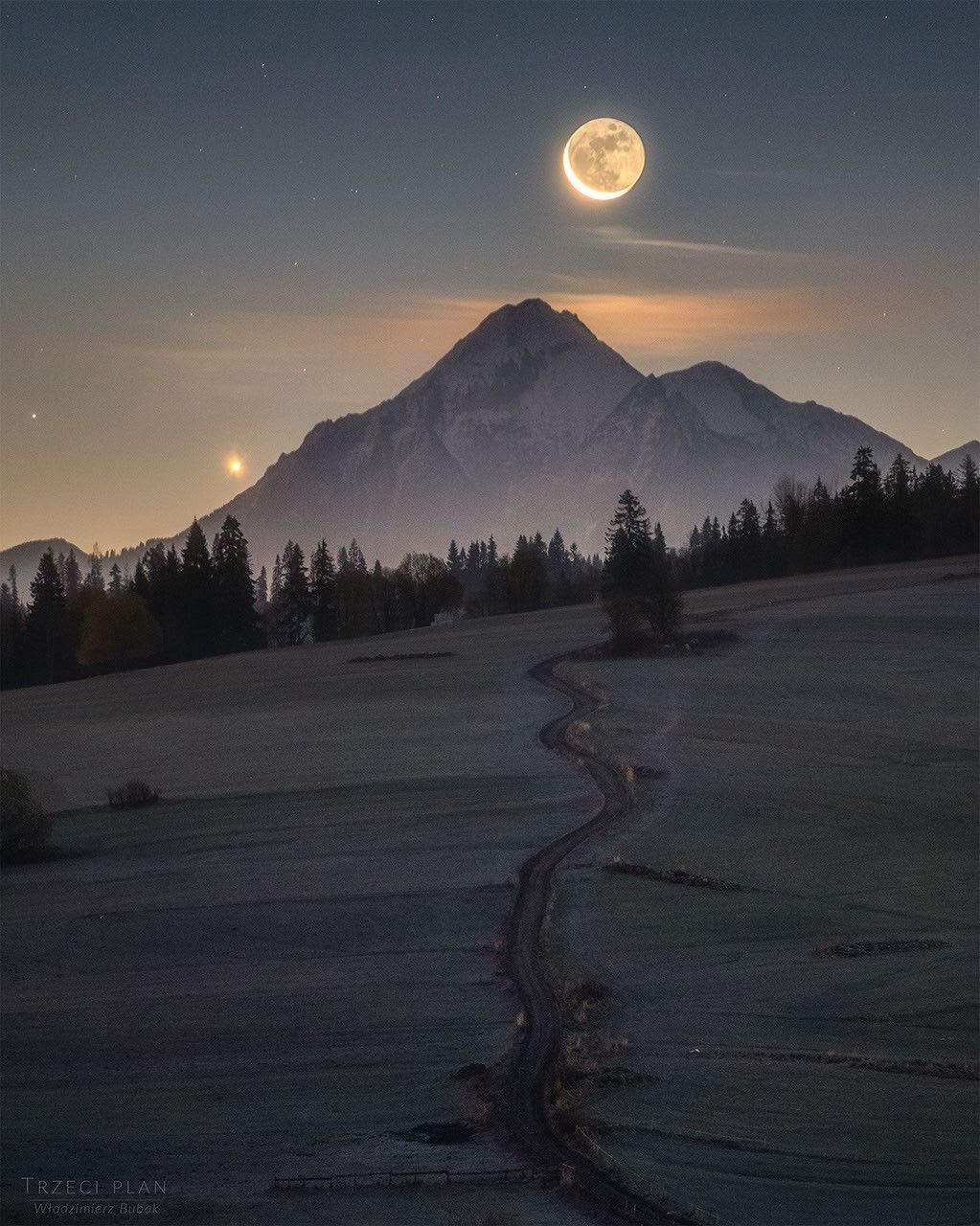
Explanation: Not all those who wander are lost. A night sky example is that planets wander, and in fact the very word "planet" comes from "wandering star" in Greek. As planets shift relative to fixed stars , they may appear from our perspective to get closer to other astronomical objects. Such meetings are called conjunctions . They don't happen by chance, but follow the precise laws of celestial mechanics . This peaceful image , captured in Poland , shows the crescent Moon above the Tatra Mountains , and bright Venus close by, a little lower in the horizon. The bright star to the left of Venus is Spica in the constellation of Virgo , the Maiden. Spica is one of the brightest stars in the sky, only about 250 light-years away. It was found in 1890 that Spica is a binary star: two massive blue stars orbiting each other every 4 days. But earlier this year it was reported that Spica, the current companion of wandering Venus, is actually a triple system . Tomorrow's picture: what's next?
NASA explores the unknown in air and space, innovates for the benefit of humanity, and inspires the world through discovery.




Loading comments…