About Us Advertise Careers Contact Us Privacy Policy Community Guidelines
Locating… 13°C English WhatsApp Alerts Email Alerts
BREAKING NEWS
Live coverage: SpaceX to launch classified payload for the U.S. Space Force Live coverage: Arianespace to launch Amazon Leo sats amid rocket crunch NASA seeks to begin ‘intergalactic freight network’ with $1.3 billion block purchase of rockets, orbital transfer vehicles Progress MS-36 set to launch to ISS from Baikonur New synthetic graphite paves way for rapid EV charging - Tech Xplore Bubbles to the rescue: Scientists make nuclear reactors better, one tiny sphere at a time - Tech Xplore New drone prototype folds itself through gaps half its width during flight - Tech Xplore BepiColombo Enters Orbit Around Mercury Despite “Software Glitch” APOD: 2026 November 24 – Galaxies Battle in the NGC 7771 Group Eruption Extends Iwo Jima’s Beach
SPACEFLIGHT

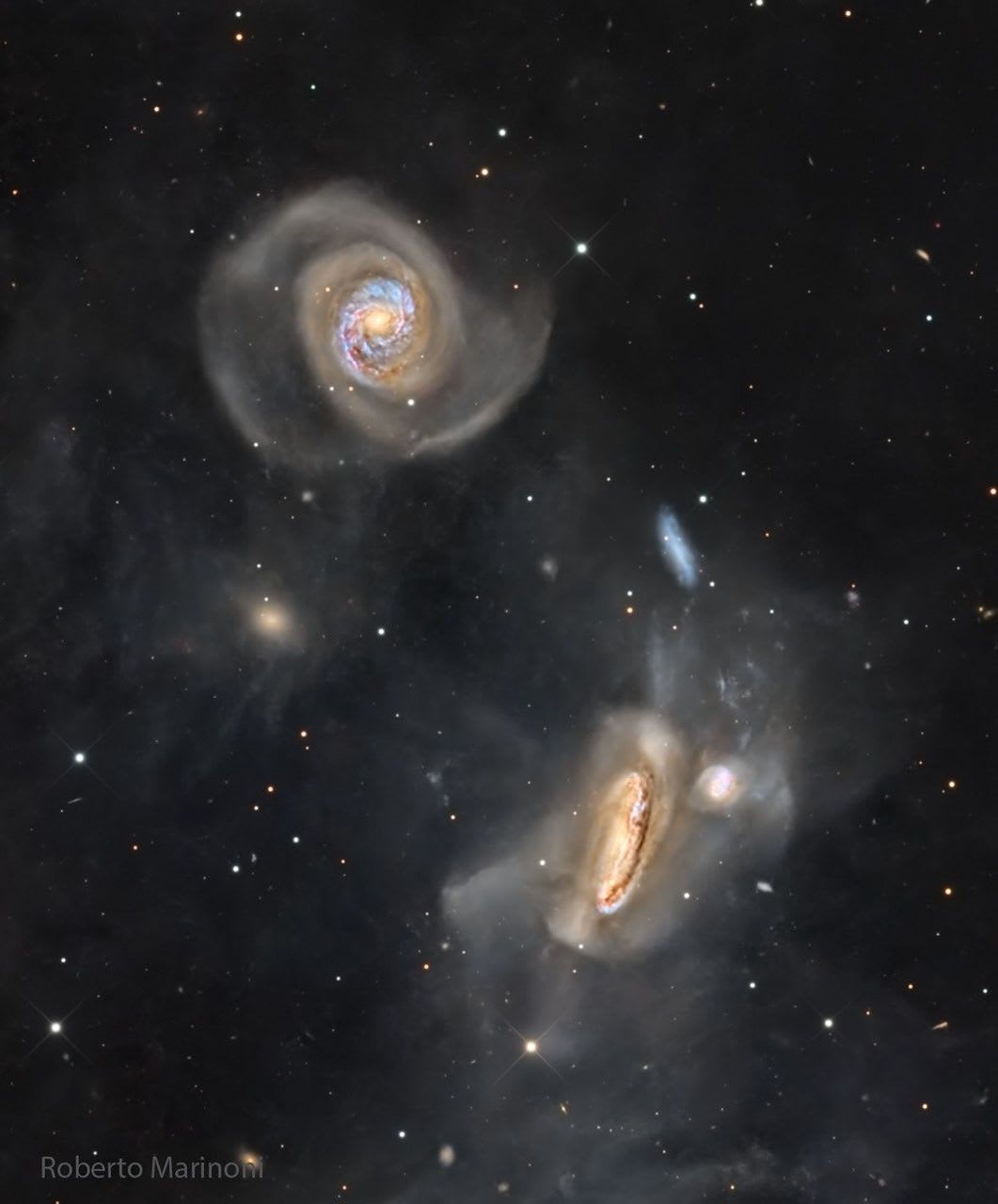
APOD: 2026 November 24 – Galaxies Battle in the NGC 7771 Group

Lanka Hit News • Nov 24, 2026 · 7h ago • 1 min read
Share:

APOD Science APOD APOD: 2026 November 24 –… Today’s APOD Archive Submissions Index Search Calendar RSS Education About Discuss   APOD Astronomy Picture of the Day Discover the cosmos! Each day a different image or photograph of our fascinating universe is featured, along with a brief explanation written by a professional astronomer. Galaxies Battle in […]

Discover the cosmos! Each day a different image or photograph of our fascinating universe is featured, along with a brief explanation written by a professional astronomer.

Explanation: After this galaxy battle, only one galaxy will remain. Already visible in the featured picture are rings and faint star swirls from previous gravitational encounters . Known collectively as the NGC 7771 Group , these galaxies lie almost 200 million light-years away toward the high-flying constellation Pegasus . The largest galaxy, barred spiral NGC 7771 on the lower right, is itself about 75,000 light-years across, and the galaxy on the upper left is spiral NGC 7769 , which is almost as large. As these and other smaller galaxies make repeated close passages, they will all likely merge into one very large galaxy. Playing out over billions of years, the merger process is understood to be a normal part of the evolution of galaxies . Studying galaxy clashes like this helps humanity to better understand the possible merger between our own Milky Way and Andromeda galaxies. Tomorrow's picture: open space

NASA explores the unknown in air and space, innovates for the benefit of humanity, and inspires the world through discovery.
Join the Conversation