
Covering the business and politics of space
Get your Icon Awards tickets before the rate goes up on Nov. 11. Join us in Washington, D.C. on Dec. 1. Secure your spot.
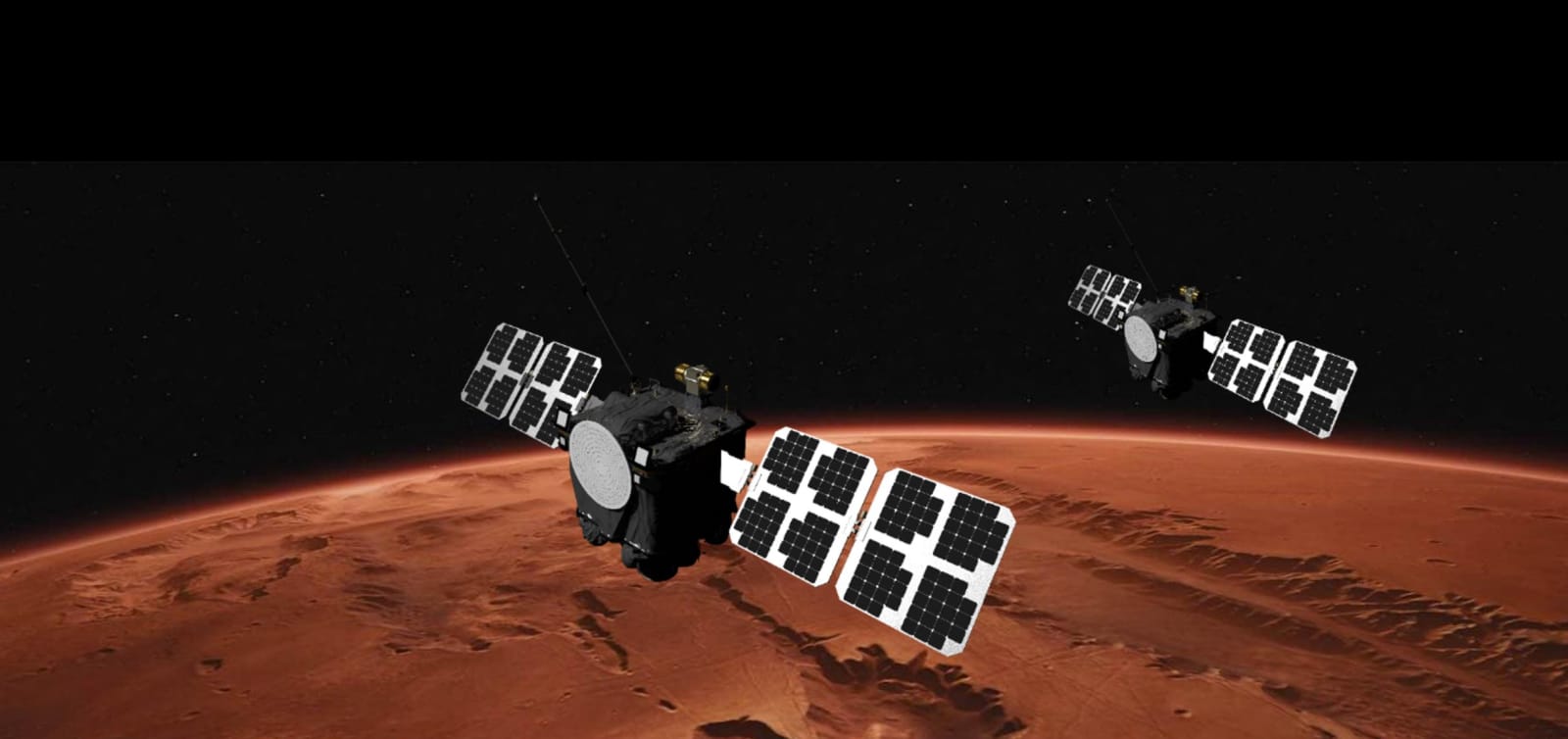
WASHINGTON — Two NASA smallsats are headed toward Mars after completing flybys of Earth nearly a year after their launch.
The second of two Escape and Plasma Acceleration and Dynamics Explorers, or ESCAPADE, spacecraft, nicknamed Gold, flew by Earth at about 6 a.m. Eastern Nov. 9, coming within about 1,050 kilometers of Earth. That took place a little more than 48 hours after the first ESCAPADE spacecraft, Blue, made a similar flyby at an altitude of about 1,600 kilometers.
During both flybys, the Rocket Lab-built spacecraft fired their engines, using a principle called the Oberth effect to maximize the performance of the maneuver. It was the first time a NASA spacecraft used such a powered flyby to go to Mars.
“This is the first time NASA has used a powered Earth flyby to propel a spacecraft toward Mars, and we’ve now executed this maneuver twice, flawlessly, in just two days,” Asal Naseri, acting associate flight director in NASA’s heliophysics division, said in an agency statement.
ESCAPADE is taking a nontraditional approach to going to Mars. Rather than launch during short windows that open roughly every two years, ESCAPADE launched last November on the second flight of Blue Origin’s New Glenn . The two spacecraft loitered around the Earth-sun L-2 Lagrange point for nearly a year before swinging around Earth in a final maneuver before heading to Mars.
That trajectory was developed by Advanced Space as a means of opening up Mars mission launch opportunities outside of traditional windows . “This method provides the flexibility to launch almost anytime and then use Earth’s gravity to get a boost to Mars, rather than waiting every two years to launch there directly when the planets are aligned,” said Jeff Parker of Advanced Space in a statement.
That approach, though, required a precise burn by each spacecraft’s main engine as they flew by Earth. “These burns were critical in the same way a Mars orbit insertion burn is,” Rob Lillis, principal investigator for ESCAPADE, said during a Nov. 9 meeting of the Mars Exploration Program Analysis Group. “I’m happy to report that they went well. They were executed perfectly.”
The maneuvers put both spacecraft on trajectories to Mars, arriving two days apart in September 2027. Each spacecraft will perform an 11-minute burn of its main engine to go into orbit around Mars, later maneuvering into its planned science orbit.
The two spacecraft will study space weather at Mars, examining how the solar wind interacts with the planet’s magnetosphere and atmosphere. The spacecraft will first perform those observations in the same orbit, separated from each other by up to 30 minutes to measure variations in space weather over time. They will later shift into separate orbits, with one spacecraft focusing on the incoming solar wind and the other on the effects on Mars.
ESCAPADE is the last surviving mission of a NASA program called SIMPLEx, or Small Innovative Missions for Planetary Exploration, intended to support low-cost planetary science missions. NASA selected ESCAPADE for development in 2019 alongside two other SIMPLEx missions, the Janus asteroid flyby spacecraft and the Lunar Trailblazer orbiter.
However, NASA canceled Janus in 2023 after delays in the launch of the Psyche asteroid mission, on which Janus was a rideshare, prevented it from carrying out its planned asteroid flybys. Lunar Trailblazer malfunctioned shortly after its launch in February 2025, and NASA formally ended the mission five months later after efforts to recover it were unsuccessful .
Two previous cubesat-class SIMPLEx missions, LunaH-Map and Q-PACE, also failed after their launches. NASA, citing budget pressures, has not solicited proposals for new SIMPLEx missions and has not stated any plans to do so for the foreseeable future.
Jeff Foust writes about space policy, commercial space, and related topics for SpaceNews. He earned a Ph.D. in planetary sciences from the Massachusetts Institute of Technology and a bachelor’s degree with honors in geophysics and planetary science... More by Jeff Foust
Sign in by entering the code we sent to , or clicking the magic link in the email.
By creating a SpaceNews.com account, you acknowledge that you have read our privacy policy and agree to our terms and conditions. This site is protected by reCAPTCHA and the Google Privacy Policy and Terms of Service apply.
We'll send a verification code to %EMAIL% .




Loading comments…