
Indias commitment to human security and its growing capabilities as a first responder in disaster relief were prominently displayed during the multinational Sahayata Setu 2026 HADR exercise led by the Indian Air Force in Jamnagar.IMAGE: Multi-agency rescue team personnel in action at Annual Joint Humanitarian Assistance and Disaster Relief Exercise Sahayata Setu 2026 at Air Force Station, in Jamnagar, Gujarat, November 19, 2026. Photograph: Amit/ANI PhotoKey PointsThe Indian Air Force showcased its air power and disaster-response capabilities in a multinational HADR exercise, Sahayata Setu 2026, at Air Force Station Jamnagar from November 17 to 19.The exercise involved coordinated operations by the three armed services, Indian Coast Guard, national disaster management agencies, civil administrations, and representatives from 24 friendly foreign countries.Chief of Defence Staff General N S Raja Subramani emphasised Indias commitment to human security and its role as a dependable first responder in the Indian Ocean Region and Indo-Pacific.The demonstration on Thursday simulated a disaster scenario, deploying Jaguar aircraft, C-130J Super Hercules, Mi-17 helicopters, Chinook, and remotely piloted quadcopters for reconnaissance, firefighting, and transport.The exercise, which began on Tuesday with a seminar, facilitated the exchange of experiences and best practices among participating nations, strengthening regional partnerships for humanitarian emergencies.The Indian Air Force on Thursday showcased its growing air power and disaster-response capabilities through a large-scale exercise involving fighter jets, transport aircraft, helicopters and remotely piloted drones as part of a multinational Humanitarian Assistance and Disaster Relief (HADR) drill in Gujarat.Showcasing Indias Disaster Response ProwessThe demonstration was part of Sahayata Setu 2026, the Annual Joint HADR Exercise (AJHE), being conducted at Air Force Station Jamnagar from November 17 to 19. The multi-agency demonstration featured coordinated operations by the three armed services (Army, Navy and Air Force), the Indian Coast Guard, national disaster management agencies, civil administrations and representatives from 24 friendly foreign countries.Chief of Defence Staff (CDS) General N S Raja Subramani attended the event on Thursday as the chief guest, along with Chief of Air Staff Air Chief Marshal Ashutosh Dixit and other senior military and civil officials.CDS Highlights Indias Commitment To Human SecuritySubramani told reporters that humanitarian assistance and disaster relief reflected Indias commitment to human security and required coordinated efforts by multiple agencies.In todays disaster-prone world, effective response is not the ability of one agency alone. It requires a coordinated whole-of-nation approach, he said.He said Indias disaster-response efforts were guided by its Neighbourhood First policy and the vision of MAHASAGAR, adding that the country had emerged as a dependable first responder in the Indian Ocean Region and the Indo-Pacific.MAHASAGAR, an acronym for Mutual and Holistic Advancement for Security and Growth Across Regions, is Indias vision for strengthening maritime cooperation and security across the Indian Ocean Region and beyond.The CDS cited Operation Dost and Operation Brahma as examples of Indias humanitarian assistance operations.Operation Dost was launched in 2023 to provide earthquake relief in Turkiye and Syria, while Operation Brahma was launched in 2025 to deliver search-and-rescue assistance, medical aid and relief supplies to Myanmar after a devastating earthquake.Disasters do not recognise geographical boundaries. Our response hence needs to transcend them, Subramani said, highlighting the importance of collective preparedness.He said the exercise focused on joint preparedness, clearly defined responsibilities, interoperability and the effective use of technology.The real test of this exercise is whether we can translate coordination into timely action, he said.Subramani expressed confidence that the lessons from the exercise would streamline preparedness and improve coordination among participating agencies.The exercise was launched in 2015 following a directive from Prime Minister Narendra Modi and is conducted annually to strengthen preparedness for natural disasters such as cyclones, floods and earthquakes.Since 2016, the three services have taken turns hosting the exercise, with the Indian Air Force (IAF) organising this years edition.Advanced Aircraft And Personnel In ActionThe exercise on Thursday simulated a disaster scenario, with participating agencies demonstrating different stages of response, beginning with aerial reconnaissance and assessment of the affected area.The IAF deployed Jaguar aircraft, C-130J Super Hercules transport aircraft, Mi-17 helicopters and remotely piloted quadcopters for the demonstration.The Jaguar fighter aircraft demonstrated its tactical and photographic reconnaissance capabilities.Multiple Advanced Light Helicopters operated by all three services took part, along with the Navys Dornier maritime reconnaissance aircraft and the IAFs Cheetah utility helicopters.The demonstrations included an Mi-17 V5 helicopter carrying a bucket to douse fires, supported by firefighting robots, while another Mi-17 1B helicopter airlifted an Army vehicle.A Chinook heavy-lift helicopter demonstrated its ability to transport structures to disaster-hit areas.The IAFs Combat Free Fall Rapid Response Force personnel also conducted a jump from an AN-32 aircraft as part of the demonstration. The specialised airborne personnel are trained to conduct high-altitude free-fall jumps for rapid tactical insertion, reconnaissance, and emergency response.International Cooperation And Regional PartnershipsThe exercise began on Tuesday with a brainstorming seminar involving representatives from friendly foreign countries associated with the Indian Ocean Rim Association, the Bay of Bengal Initiative for Multi-Sectoral Technical and Economic Cooperation, and the Quadrilateral Security Dialogue (Quad), the defence ministry said.The participating countries included Australia, Bangladesh, Comoros, Indonesia, Kenya, Madagascar, Malaysia, Maldives, Mauritius, Mozambique, Oman, Seychelles, Singapore, Somalia, South Africa, Sri Lanka, Tanzania, Thailand, the UAE, Yemen, Japan, the US, Myanmar and Nepal.Their participation facilitated the exchange of experiences and best practices and highlighted the importance of regional partnerships and collective preparedness in responding to humanitarian emergencies, it said.The exercise included a tabletop exercise for joint decision-making and response planning, as well as a static display of equipment and capabilities. It also included a meeting of the Quad HADR Working Group to strengthen regional disaster-response mechanisms and capacity building, the defence ministry said.The exercise culminated on Thursday with a Multi-Agency Capability Demonstration, followed by interactions between participating foreign delegates and Indian officials, it said.
POLITICS
IAF showcases air power, disaster-response muscle at 24-nation drill
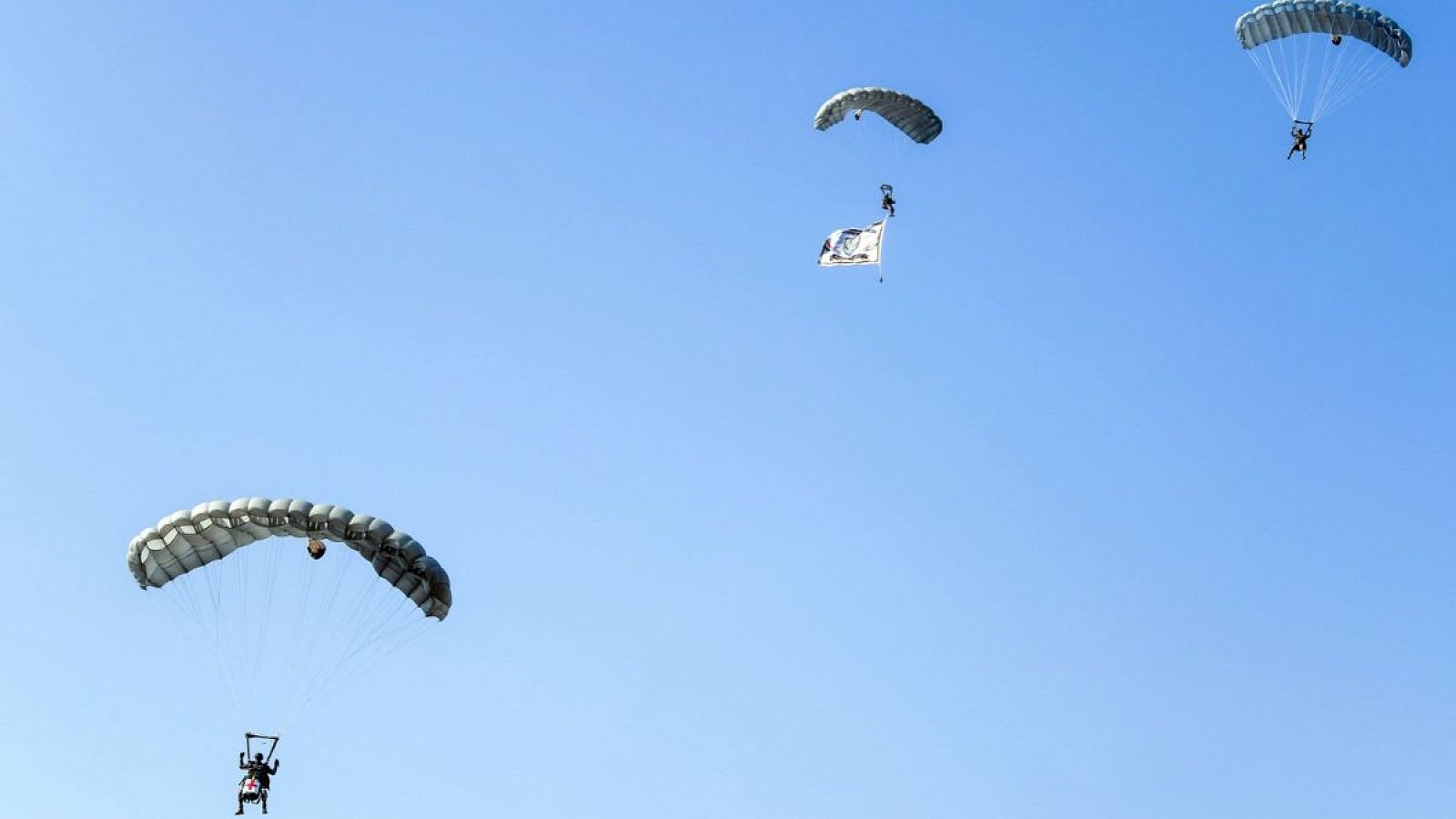
Indias commitment to human security and its growing capabilities as a first responder in disaster relief were prominently displayed during the multinational Sahayata Setu 2026 HADR exercise led by the Indian Air Force in Jamnagar.IMAGE: Multi-agency rescue team personnel in actio
You May Also Like
View All ›
1st Test: Nicholls unbeaten on 146, Phillips hits 118 as NZ reach 317/6 against India

Live coverage: SpaceX to launch classified payload for the U.S. Space Force
Phillips Breaks Huge Record, Emulates Rohit For Rare Test Cricket Feat
Sri Lanka ekes out 82-run lead as Pakistan pacers toil to stay in control of 2nd Test
Loading comments…