
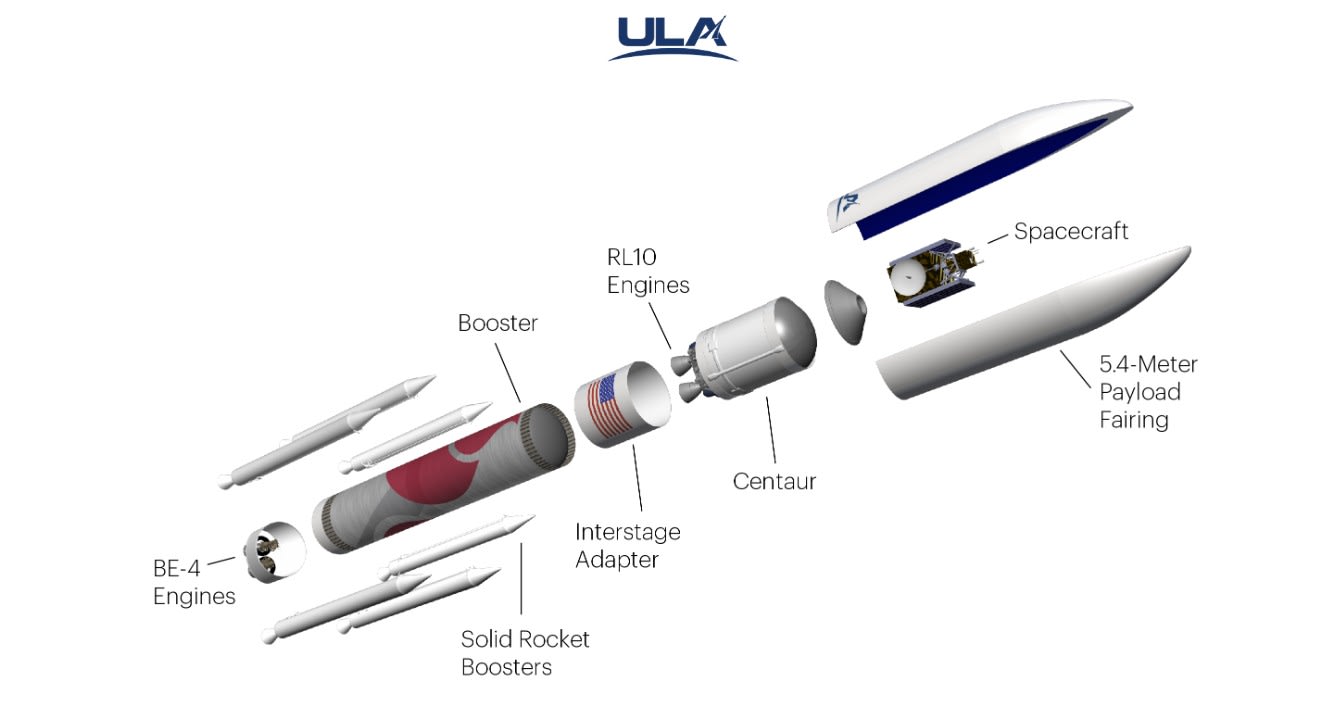
The United Launch Alliance said today that insufficient fuel flow from the launch vehicle to the BE-4 engines may have led to the failure of Vulcan Leo 1 on Sunday.
The fifth flight of ULA’s new Vulcan rocket failed about 10 minutes after liftoff on November 15, the company’s first total failure in 20 years of operation.
By yesterday they had traced the problem to “low booster performance,” referring to the rocket’s first stage. The first stage is powered by two BE-4 liquid methane/liquid oxygen (methalox) engines built by Blue Origin, which uses them for its own New Glenn rocket.
In an update today, ULA says preliminary indications are that it was not the engines themselves, but “inadequate fuel supply from the vehicle” to the engines.
ULA has completed an initial integrated review of flight data from the Leo 1 launch anomaly that occurred last Sunday. While work remains to determine cause, preliminary indications are that the low booster thrust was the result of inadequate fuel supply from the vehicle to the BE-4 engines, not from the performance of the engines.
As shared previously, the Vulcan second stage appears to have started nominally, and the RL10 engines were operating as planned. The second stage was performing well but was unable to recover from the performance loss resulting in loss of mission.
All indications are that the solid rocket booster performance was nominal, following nozzle improvements implemented for this launch.
As the investigation continues, we will provide updates when there is information to share. – Statement from ULA, November 18, 2026
Vulcan is a two-stage rocket. The first stage, also called the booster or core stage, uses the BE-4 engines, while the second stage, Centaur V, uses two Aerojet Rocketdyne RL10s. Vulcan can be augmented with two, four, or six Northrop Grumman Solid Rocket Boosters on the side if additional thrust is needed.
Sunday’s launch of 40 satellites for Amazon’s satellite internet communications constellation Amazon Leo (formerly Project Kuiper), required six SRBs. It was the 10th ULA launch for Amazon Leo, but the previous nine were on the Atlas V rocket that Vulcan is replacing.
This was the fifth flight of Vulcan, ULA’s replacement for the Atlas V and Delta IV rockets that have been the mainstay of their fleet since the company was founded in 2006. Atlas V has a 100 percent mission success record, but uses Russian RD-180 engines. Following Russia’s annexation of Ukraine’s Crimea Peninsula in 2014, Congress required ULA to end U.S. reliance on Russian engines for national security launches. Although the law allowed Atlas to be used for civil and commercial launches, ULA decided to phase out both Atlas V and Delta IV and replace them with Vulcan. Delta IV also had a 100 percent success rate between 2006 and its final launch in 2024 . Six Atlases remain, but are under contract to Boeing for Starliner.
Vulcan’s first flight in 2024 was a complete success. However, on flights two and four , in 2024 and 2026 respectively, nozzles on the Northrop Grumman SRBs malfunctioned. Vulcan’s core stage compensated for the underperformance and delivered the payloads to their intended destinations so they count as mission successes, but the U.S. Space Force has been hesitant to use Vulcan until the anomalies are resolved. Sunday’s launch was intended to be proof that they were.
ULA is a 50-50 joint venture between Boeing and Lockheed Martin.
SpacePolicyOnline.com has the right (but not the obligation) to monitor the comments and to remove any materials it deems inappropriate. We do not post comments that include links to other websites since we have no control over that content nor can we verify the security of such links.


Loading comments…