
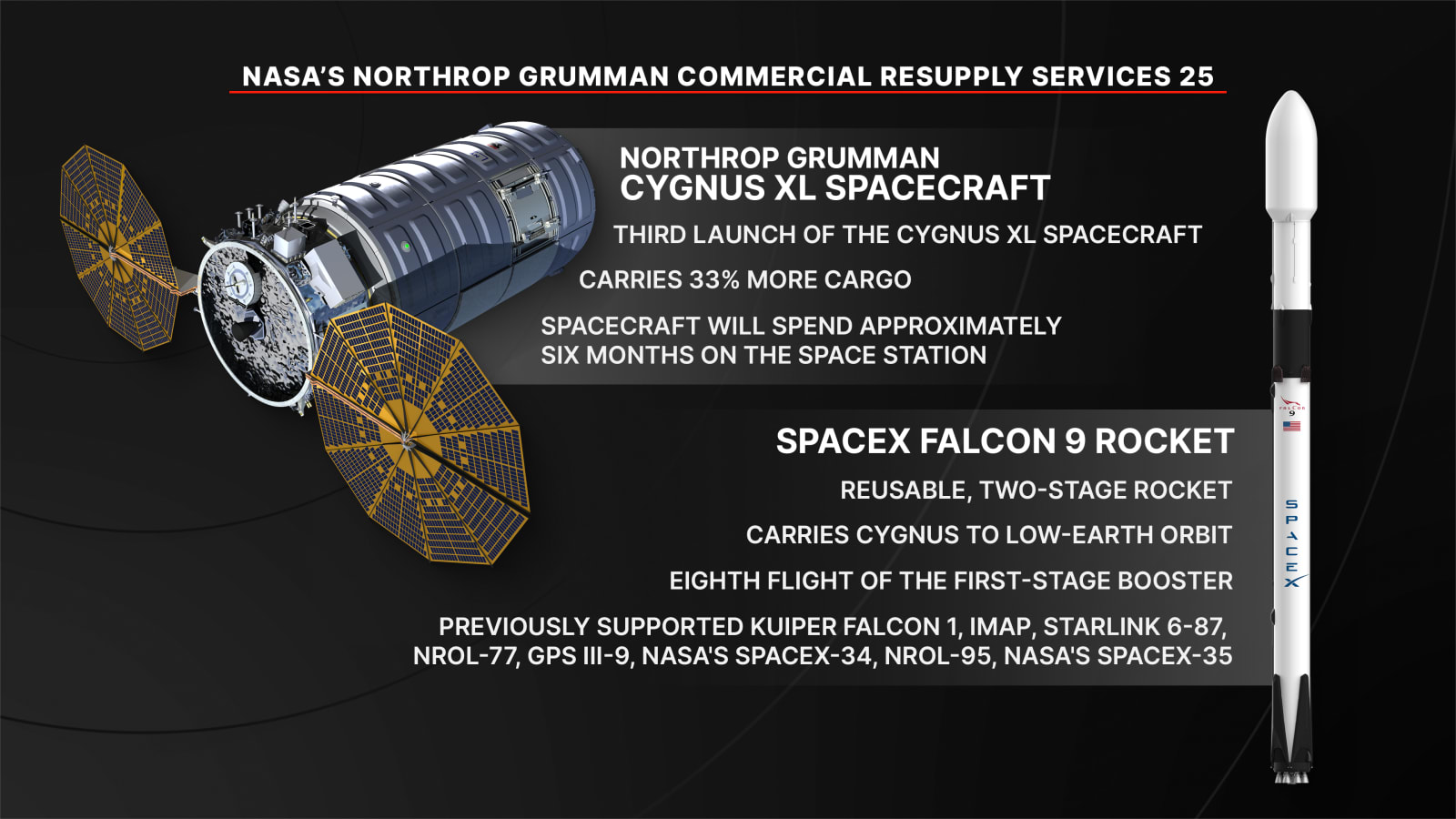
NASA’s Northrop Grumman Commercial Resupply Services 25 mission, or Northrop Grumman CRS-25, will deliver about 11,000 pounds of science and supplies to the International Space Station. The mission will be the third flight of the company’s Cygnus XL, the larger, more cargo-capable version of the company’s solar-powered spacecraft.
The Cygnus XL will launch aboard a SpaceX Falcon 9 rocket from the Cape Canaveral Space Force Station in Florida. Following arrival to the station, astronauts aboard the space station will use the Canadarm2 to grapple the spacecraft before ground controllers robotically install it to the Unity module’s Earth-facing port for cargo unloading.
In addition to food, supplies, and equipment for the crew, Cygnus will deliver several new experiments aimed at improving drug delivery for cancer and osteoarthritis treatment, predicting cancer spread, advancing treatments for muscle loss, improving radiation sensing, and supporting food production for future long-duration missions. This research includes:
Cardinal Muscle 2.0 uses the microgravity environment to explore potential treatments for muscle loss. Muscle atrophy and strength loss experienced by astronauts after spaceflight share many features with age-related muscle decline on Earth and occur more rapidly in microgravity without exercise. Researchers will use a muscle tissue model to test different Food and Drug Administration-approved drugs used to treat other conditions can be repurposed to prevent or reduce muscle loss.
The DNA Nano B investigation uses microgravity to manufacture tiny, DNA-inspired particles designed to deliver medicine into dense tissues, such as cartilage and solid tumors. Microgravity may enable more uniform particle assembly, helping researchers refine production methods. The results could advance targeted treatments for cancer and osteoarthritis on Earth.
The Active Radiation Environment Sensor ( ARES ) will test a small radiation monitoring device to support future Artemis program and lunar missions. The system is designed to integrate with spacecraft systems and provide real-time radiation monitoring inside crew living areas. The results could inform radiation monitoring strategies and crew safety measures for future exploration missions.
Encapsulate-1 uses miniature replicas of patients’ tumors to study how cancer cells move, invade surrounding tissues, and potentially spread. Researchers aim to develop a space-based diagnostic tool that could predict cancer progression months or even years in advance, improving early detection and treatment decisions for patients on Earth.
Ohalo III is a new plant growth facility designed to help food crop production on future long-duration missions. The mostly automated system uses innovative water recovery and air exchange technologies to grow a variety of crops. This research could help lead to better food production methods to keep crew healthy and fed on future exploration missions, including those to Mars.
JOining demonstrations IN-Space (JOINS) will mature technologies that allow robotic systems to join materials directly in space. In-space joining could enable large structures to be assembled and integrated after launch rather than being constrained by the size and volume of a launch vehicle. These capabilities may be needed to build and repair large infrastructure, such as structures that will to support future exploration under Moon Base .
Testing technologies in space helps validate their performance in unique environmental conditions, matures their readiness for operational use, reduces technical risk, and builds confidence for future mission applications.
Additional supplies being flown to the space station include:
To learn more about NASA’s work in low Earth orbit, visit:
https://www.nasa.gov/international-space-station
National Aeronautics and Space Administration NASA explores the unknown in air and space, innovates for the benefit of humanity, and inspires the world through discovery.


Loading comments…