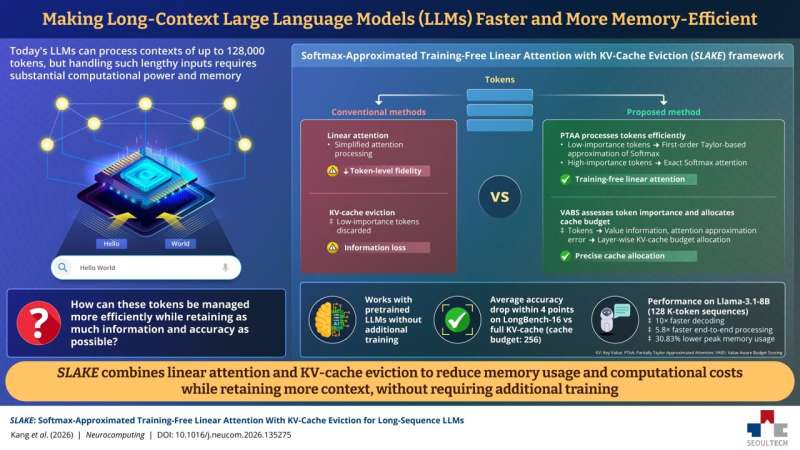
When we give a large language model (LLM), such as GPT-4, Llama or Mistral, a task such as summarizing a lengthy research paper or a conversation, it first breaks the text into smaller units called tokens. The model then processes these tokens to understand the text and generate a response. Today's LLMs can process inputs exceeding 128,000 tokens. However, processing such long inputs places considerable demands on computing power and memory.
When we give a large language model (LLM), such as GPT-4, Llama or Mistral, a task such as summarizing a lengthy research paper or a conversation, it first breaks the text into smaller units called tokens.
The model then processes these tokens to understand the text and generate a response.Today's LLMs can process inputs exceeding 128,000 tokens.
However, processing such long inputs places considerable demands on computing power and memory.

Loading comments…