
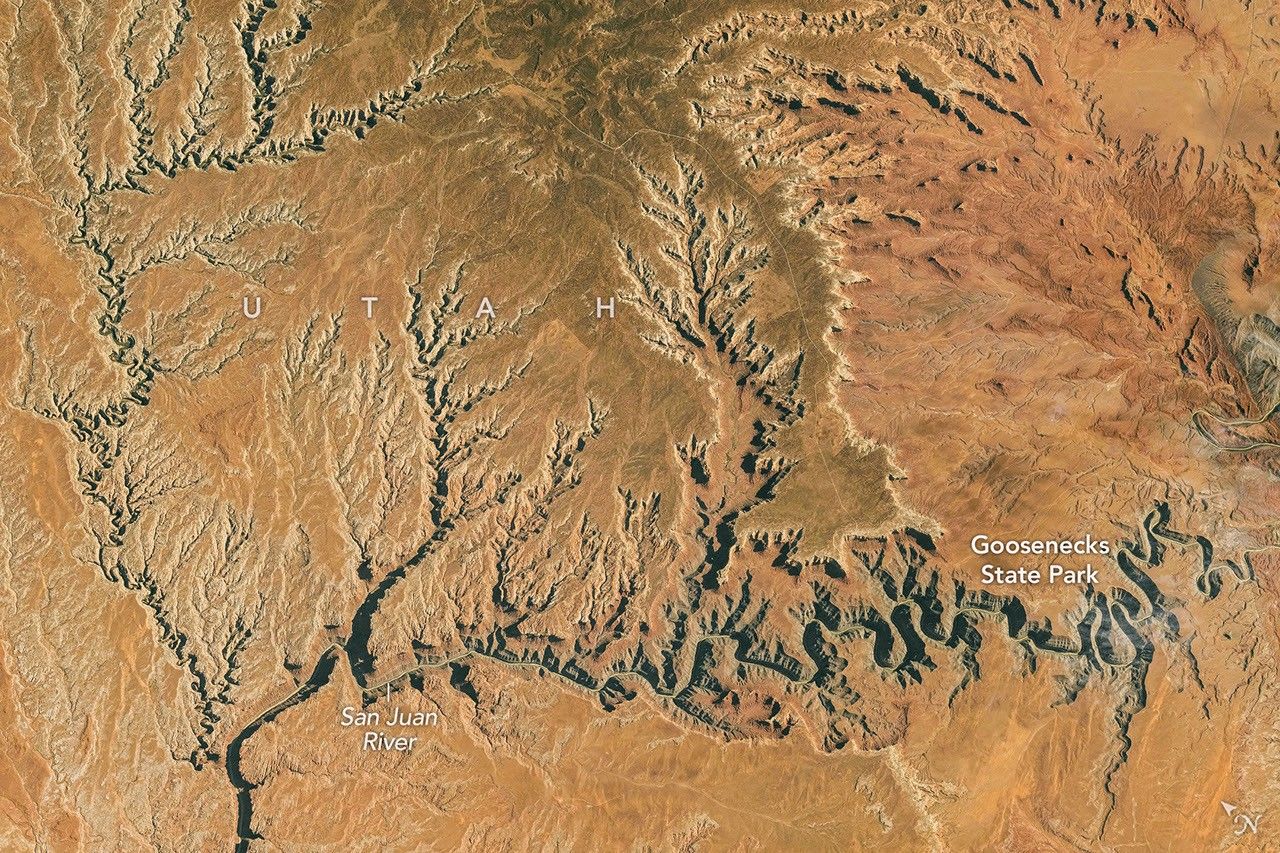
Tens of millions of years ago, the San Juan River in what is now southern Utah shared some characteristics with today's Mississippi River. In a bygone geologic era, the San Juan flowed across a relatively flat plain that formed in an ancient marine environment. Unencumbered by rugged terrain, the river was free to take a long, meandering path on its gradual journey downslope.
But this part of the San Juan changed when geologic forces pushed the Colorado Plateau upward. Some experts think that within the later stages of this “ still-enigmatic ” history, starting around 20 million years ago, the plateau’s rise elevated the San Juan’s headwaters , which increased the river’s gradient and sped its flow. With that, the water’s erosive power intensified, and the river started carving its winding path deeper and deeper through 300-million-year-old rock.
Today, on its westward path to Lake Powell, the San Juan River flows through an impressive series of entrenched meanders, also known as “goosenecks.” An astronaut aboard the International Space Station photographed the stark desert topography on October 6, 2026.
In Utah’s Goosenecks State Park , the river runs through a canyon 1,000 feet (300 meters) deep. In places, it nearly loops back on itself, making horseshoe-shaped bends. One section is so curvy that the river travels 5.5 miles (8.9 kilometers) between two points that are only 1.3 miles (2.1 kilometers) apart as the crow—nay, goose—flies.
While the goosenecks are an unusual geologic wonder to behold by day, the area’s dark skies are a spectacle by night. Goosenecks State Park’s remote, high-desert location and 360-degree views of the sky helped earn it an International Dark Sky Park designation in 2021. According to DarkSky International, features such as the Double Cluster in Perseus and the Messier 24 star cloud in the Sagittarius spiral arm of the Milky Way are visible to the unaided eye from the park. In November 2026 , dark skies offer the chance to view several meteor showers, with the Northern Taurids, Southern Taurids, and Leonids reaching their peaks throughout the month.
Astronaut photograph ISS075-E-188830 was acquired on October 6, 2026, with a Nikon Z9 digital camera using a focal length of 400 millimeters. It is provided by the ISS Crew Earth Observations Facility and the Earth Science and Remote Sensing Unit at NASA Johnson Space Center. The image was taken by a member of the Expedition 75 crew. The image has been cropped and enhanced to improve contrast, and lens artifacts have been removed. The International Space Station Program supports the laboratory as part of the ISS National Lab to help astronauts take pictures of Earth that will be of the greatest value to scientists and the public, and to make those images freely available on the internet. Additional images taken by astronauts and cosmonauts can be viewed at the NASA/JSC Gateway to Astronaut Photography of Earth . Photo by Bob Wick (BLM) , via Flickr. Story by Lindsey Doermann.
Stay up-to-date with the latest content from NASA as we explore the universe and discover more about our home planet.
Snow-capped mountains carved by deep river valleys preside over northwestern Washington state.
The meandering Congaree River sustains towering forest ecosystems and fashions oxbow lakes as it shifts across its floodplain.
Over the years, astronauts aboard the International Space Station have photographed several of the cities hosting the 2026 FIFA World…
NASA's Earth Observatory brings you the Earth, every day, with in-depth stories and stunning imagery.
Open access to NASA’s archive of Earth science data
NASA explores the unknown in air and space, innovates for the benefit of humanity, and inspires the world through discovery.


Loading comments…