
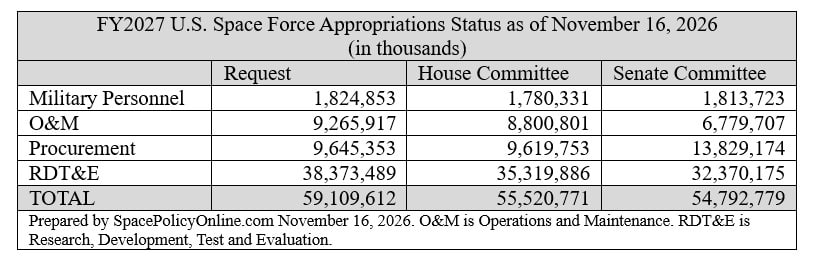
The Senate Appropriations Committee released its FY2027 defense spending bill last night. The total includes $1.072 trillion for DOD, essentially the same as the Trump Administration’s appropriations request, but it incorporates some of the additional spending the Administration wanted through a separate reconciliation bill. The U.S. Space Force would get $54.8 billion versus the $59.1 billion requested.
President Trump is requesting a “generational” investment in defense, a total of $1.5 trillion for FY2027 of which $1.15 trillion is through the appropriations process and another $350 billion through a separate reconciliation bill. The U.S. Space Force request is $71.1 billion: $59.1 billion in appropriations plus $12 billion through reconciliation. By comparison, the Space Force got $32 billion in FY2026.
The Senate committee agreed with much, but not all, of the requested appropriations increase for the Space Force.
The committee’s report highlights that they increased funding for the development of space-based airborne moving target indicators (AMTI) by $2 billion as well as adding $3.3 billion for the Space Data Network (SDN), $520 million for the Next Generation Overhead Persistent Infrared Polar Program, and $88 million for space-based Commercial ISR focused on Responsive Combatant Command Tasking. They also provide $7.1 billion for 54 National Security Space Launches.
On the other hand, they are concerned about the Space Force and the National Reconnaissance Office utilizing “non-competitive sole-source contracts.” AMTI and SDN were singled out as examples of the Space Force abandoning “meaningful competition in favor of sole-source awards.” Both went to SpaceX: $4.16 billion for AMTI and $2.29 billion for SDN.
The committee wants the additional funding it is providing for those two programs to be directed at ensuring multiple vendors, noting that section 8127 of the bill limits the use of funds for sole-source or non-competitive contract awards.
Section 8127 would codify that in law:
The committee also provides additional funding for commercial space-based sensing, in-orbit refueling, advanced propulsion system testing infrastructure for emerging commercial launch capabilities, non-federal spaceports, and expanding Protected Tactical SATCOM-Global (PTS-G) to meet the original program objectives.
Overall, the committee is recommending $1.072 trillion for DOD, essentially the same as the request and what was approved by the House Appropriations Committee. (The request for DOD is part of the total $1.15 trillion for defense, which includes funding for non-DOD agencies like the Department of Energy that oversees the nation’s nuclear stockpile.)
The fate of the $350 billion requested for DOD through reconciliation, including $12 billion for the Space Force, remains unsettled. Reconciliation is a separate process outside the jurisdiction of appropriations committees. It’s used in the Senate where a reconciliation bill can pass with a simple majority of 51 votes instead of the 60 needed to avoid a filibuster. Two have been enacted already in this Congress — last summer’s One, Big Beautiful Bill Act (or the Working Families Tax Cut Act) and this year’s Secure America Act — and the Administration’s efforts to get Congress to pass a third, with another $350 billion for DOD, is meeting with resistance from both parties. The House approved $60 billion as part of a broader $95 billion budget resolution in July, the first step in the reconciliation process. Rumors are the Senate may try to move something soon, but how much money will be included for DOD is an open question.
More broadly, reconciliation funding is one-year money, not a reliable stream like appropriations. In a statement accompanying release of the bill, subcommittee chair Sen. Mitch McConnell (R-Kentucky) stressed the need for “consistent investment, year after year,” not “one-time surges of cash.”
“This bill is a roadmap to sustainably and responsibly delivering generational investments in the national defense, … The nature of warfare is changing, and America’s adversaries are working together to threaten us. Deterring these threats is a project bigger than one-time surges of cash. From expanding critical munitions production to reviving American shipbuilding to holding our edge in developing future weapons, tomorrow’s joint force will need consistent investment, year after year. I’m proud of the Subcommittee’s work toward an historic new baseline and a full-year investment in this generational project.” — Sen. Mitch McConnell
To that end, the committee includes $69 billion of the $350 billion in this bill. None of that appears to be for the Space Force, however.
Almost all of the funding for the Golden Dome missile defense project was slated to come through reconciliation: $17.1 billion of the $17.5 billion requested. The committee provides $9.4 billion of the $17.1 billion in this bill.
The text , report , and summary are on the committee’s website.
The committee now has released all 12 of their bills. Committee chair Sen. Susan Collins (R-Maine) hasn’t announced if and when the committee will meet to debate them. The House Appropriations Committee cleared all their bills over the summer, but none have passed the House.
The government is currently operating under a Continuing Resolution (CR) that expires on December 11. Many expect the CR will be extended into next year, but with Democrats taking control of the House and Senate on January 3, it’s possible Republicans could try to complete action on at least some of the bills before then, though time is short. A government shutdown isn’t out of the question, but at this moment appears unlikely.
SpacePolicyOnline.com has the right (but not the obligation) to monitor the comments and to remove any materials it deems inappropriate. We do not post comments that include links to other websites since we have no control over that content nor can we verify the security of such links.


Loading comments…